Enterprise Guide
Bitcoin Mining Power Supply Guide 2026
Bitcoin miners draw 3.5–20 kW, 24/7. Size your power supply, PDU and three-phase service from real catalog specs before you order. Request a quote today.
#Power #PDU #Infrastructure
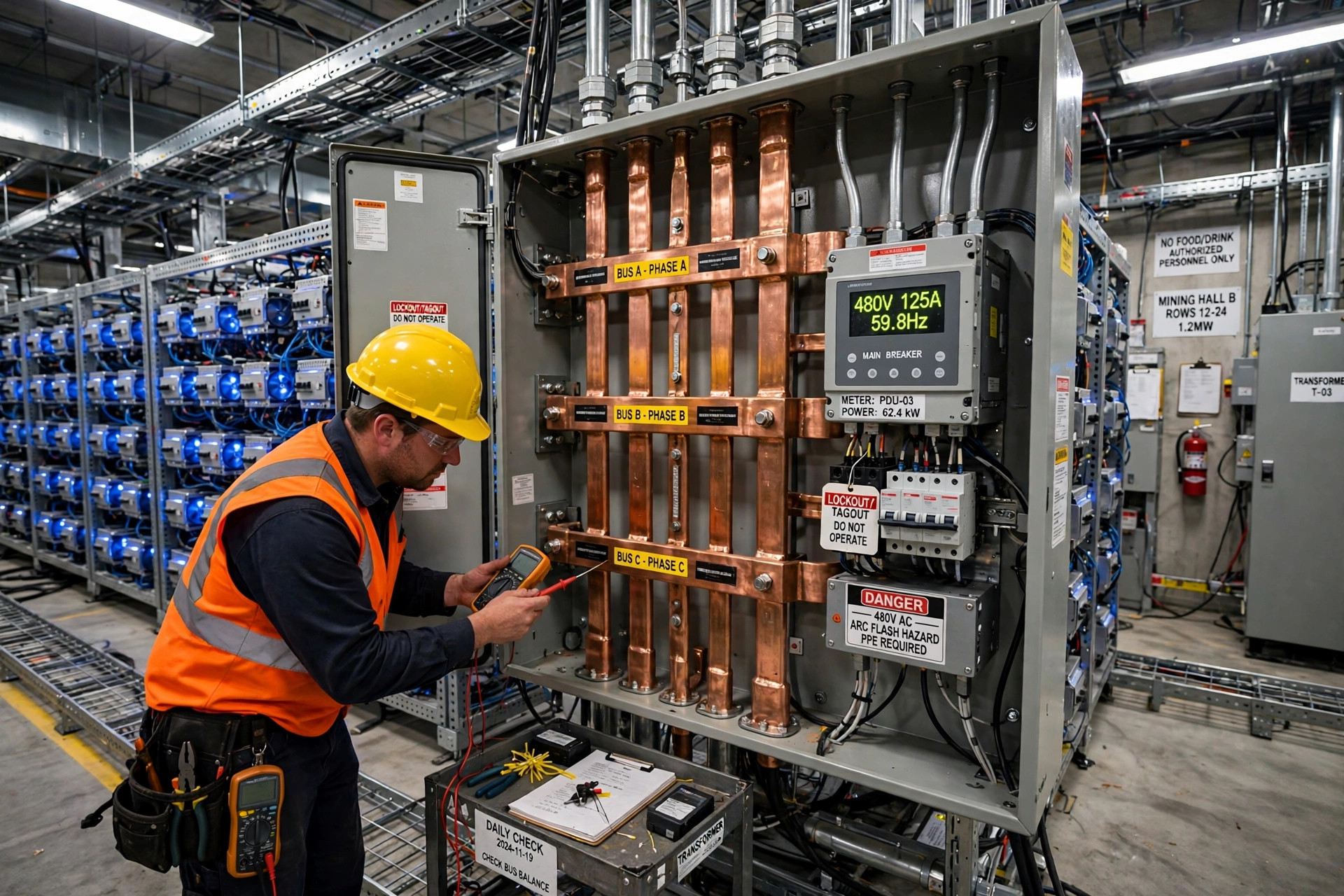
A Bitcoin miner is a continuous electrical load: a single Antminer S21 Pro draws 3,510 W, 24 hours a day, and a Whatsminer M79S draws 20,000 W. Before you order hardware, size three things — the miner's own draw, the breaker and PDU that feed it, and the cooling that rejects its heat. This guide works through all three from real MineForgeX catalog specs, so the power bill and the electrical bill of materials hold no surprises.
How Much Power Does a Bitcoin Miner Draw?
Every miner in the MineForgeX catalog lists its power draw in watts, and the range is wide: from 2,780 W for a Zcash ASIC to 20,000 W for a rack-scale hydro unit. The table below is the starting point for any power plan — watts are what your service, your breaker and your PDU all have to carry.
| Model | Hashrate | Power | Efficiency | Voltage | Price |
|---|---|---|---|---|---|
| Antminer S21 Pro | 234 TH/s | 3,510 W | 15.0 J/TH | 200–240V | $3,490 |
| Antminer S23 | 318 TH/s | 3,498 W | 11.0 J/TH | 200–240V | $7,750 |
| Whatsminer M60S+ | 210 TH/s | 3,570 W | 17.0 J/TH | 200–240V | $2,880 |
| Avalon A16XP | 300 TH/s | 3,850 W | 12.8 J/TH | 200–240V | $5,000 |
| Antminer S23 Hyd | 580 TH/s | 5,510 W | 9.5 J/TH | 380–415V 3-phase | $13,300 |
| Antminer S23e Hyd 2U | 865 TH/s | 8,650 W | 10.0 J/TH | 380–415V 3-phase | $9,529 |
| Whatsminer M7AS+ | 540 TH/s | 6,750 W | 12.5 J/TH | 380–480V 3-phase | $7,000 |
| Whatsminer M79S | 1,350 TH/s | 20,000 W | 14.8 J/TH | 380–415V 3-phase | $12,100 |
Watts become kilowatt-hours fast, because miners never sleep. One watt drawn continuously is 8.76 kWh a year, so at $0.08/kWh every watt costs $0.70 a year. An Antminer S21 Pro at 3,510 W uses about 30,748 kWh a year — roughly $2,460 at $0.08/kWh. A single M79S at 20,000 W uses 175,200 kWh a year — about $14,016 at the same rate. That is arithmetic at a fixed power price, not a forecast: your rate and your efficiency decide the bill, and the calculator on this site runs the same math at your own $/kWh.
Efficiency Is the Power Bill
Power draw is hashrate times efficiency: a 234 TH/s miner at 15.0 J/TH draws 3,510 W by definition. Two miners with the same hashrate can draw very different power — the S23 Hyd's 9.5 J/TH against the S21 Pro's 15.0 J/TH is a 37% smaller electricity bill for the same terahashes. When you compare models, compare watts per terahash first and price per terahash second.
Single-Phase vs Three-Phase: What Plugs in Where
Air-cooled miners run on ordinary single-phase power: 200–240V, the same voltage class as a heavy household appliance circuit, and every air-cooled model in the catalog — S21 Pro, S23 318T, M60S+, A16XP, SealMiner A4 Pro Air — takes it. Hydro and immersion miners are different equipment: every hydro model needs 380–415V three-phase power and a liquid-cooling loop, and it will not run without both. That is the single most common ordering mistake in mining: a hydro miner delivered to a site with no three-phase supply is a paperweight until the electrician arrives.
The Home-Miner Exception
The ForgeTank 2 immersion tank is the exception that proves the rule: it runs on 200–240V single-phase power and holds two air-cooled miners, so a garage or office deployment can stay single-phase — but only for two miners, and the miners inside still draw their full wattage. Past two miners, or past air cooling, you are in three-phase territory.
The 80% Rule: Size Breakers for a Load That Never Sleeps
Electrical codes treat any load that runs for three hours or more as a continuous load, and the National Electrical Code (NEC 210.19(A) and 210.20(A)) requires the breaker and conductors to be sized at 125% of a continuous load — the "80% rule" stated the other way round. A Bitcoin miner runs 24 hours a day, so it is a continuous load by definition, and sizing to the nameplate wattage with no headroom is how breakers trip at 2 a.m.
Worked example: an S21 Pro draws 3,510 W. On a 240V circuit that is 14.6 A continuous (3,510 ÷ 240). The breaker must be rated at least 14.6 × 1.25 = 18.3 A, so a 20 A breaker on a dedicated circuit is the minimum — and "dedicated" matters, because anything else sharing that circuit eats the headroom.
A hydro unit on three-phase power works the same way, per phase: an S23 Hyd draws 5,510 W across three phases at 415V, about 7.7 A per phase (5,510 ÷ (415 × 1.732)), so the three-phase breaker must be rated at least 9.6 A per phase. In practice the circuit is sized with the PDU and the cooling loop together, which is the next section.
Standard breaker sizes and the continuous load each can carry:
| Breaker rating | Maximum continuous load |
|---|---|
| 15 A | 12 A |
| 20 A | 16 A |
| 30 A | 24 A |
| 50 A | 40 A |
| 100 A | 80 A |
Breakers specifically listed as 100%-rated are the exception and can carry their full rating continuously — check the listing, don't assume it.
PDUs and Distribution: Getting Power to the Rack
A rack of miners needs a power distribution unit, and the numbers matter more than the brand. The Enterprise Smart PDU is a 415V 63A three-phase unit rated for 45 kW of continuous load (415 × 63 × 1.732 ≈ 45.3 kW), with per-phase digital metering, SNMP monitoring, per-branch breakers and C19/C20 locking outlets, at $1,190 with a 36-month warranty. Twelve S21 Pro units draw 42.1 kW between them — inside one PDU's 45 kW rating, with headroom. Eight S23 Hyd units draw 44.1 kW — also one PDU, but only just, and only eight of them.
One Circuit per Miner
Give every miner its own branch circuit and its own breaker. Daisy-chaining miners on shared circuits is how a single fault takes down a rack, and it makes the 80% rule impossible to verify per circuit. The PDU's per-branch breakers exist for exactly this: one miner, one breaker, one metered feed.
Don't Forget the Cooling Load
Miners turn nearly all of their electricity into heat, and removing that heat takes power of its own. A 120 kW dry cooler draws 2,200 W of fan and pump power; the 240 kW adiabatic unit draws 4,200 W. Those are small numbers next to a 44 kW miner load, but they belong in the service calculation — and they run on 380–480V three-phase power, so they need their own circuits, not a spare socket on the miner PDU.
At container scale the cooling load is part of the package: the 40 ft hydro container is rated for 1.6 MW of miners, the 20 ft immersion container for 800 kW, and the 40 ft air-cooled container for 1.5 MW. When you price a container, price the transformer and the service for the full rating, not for the first miners you put in it.
Sizing Your Service: Two Worked Examples
Example one — ten S21 Pro air miners: 10 × 3,510 W = 35.1 kW of miner load. The feeder must carry 125% of that continuous load, 43.9 kW, and a single 45 kW PDU covers the fleet with headroom to spare. The site needs a 200–240V single-phase service of at least 44 kW — about 183 A at 240V — before lighting, cooling fans and anything else.
Example two — eight S23 Hyd hydro miners plus cooling: 8 × 5,510 W = 44.1 kW of miner load, plus a 120 kW dry cooler at 2.2 kW, for 46.3 kW total. At 125% the service must carry 57.9 kW, so size it for 60 kW of three-phase power at 380–415V, split across two PDUs — four miners per PDU — with the cooler on its own circuit.
Who this guide is for: anyone buying more than two miners, or any hydro or immersion unit, or anyone whose electrician has asked "how many amps?" and is waiting for an answer. Who it is not for: a single air-cooled miner on a dedicated 20 A circuit, which needs an electrician and a socket, not a power plan.
One clear next step: list the models and quantities you want, add up the watts, multiply by 1.25, and check that number against your service before you order. If your site cannot carry the load, the Bitcoin mining hosting guide covers colocation from $0.045/kWh all-in as the alternative — and request a quote with the model, quantity and your power price, so the quote prices the right electrical package with the hardware.
Frequently Asked Questions
Can I run a Bitcoin miner on a normal household outlet?
An air-cooled miner on 200–240V single-phase power can run on a dedicated 20 A circuit — an S21 Pro needs 14.6 A continuous, so a 20 A breaker is the minimum. A standard 120V household outlet cannot: the voltage is wrong and the current is far too high. Hydro and immersion miners need 380–415V three-phase power and cannot run on household supply at all.
How many miners can one PDU run?
The Enterprise PDU is rated for 45 kW continuous: twelve S21 Pro units (42.1 kW), twelve M60S+ units (42.8 kW) or eight S23 Hyd units (44.1 kW). The limit is watts, not sockets — add up the miners' draw and stay under 45 kW, with the 80% rule already built into the PDU's continuous rating.
What size breaker does one Antminer S21 Pro need?
A 20 A breaker on a dedicated 240V circuit, minimum: 3,510 W ÷ 240V = 14.6 A continuous, × 1.25 = 18.3 A. A 15 A breaker is undersized and will trip; a shared circuit is worse. Have a licensed electrician confirm the wire gauge and the panel capacity.
Do I need three-phase power for hydro miners?
Yes. Every hydro and immersion miner in the catalog — S23 Hyd, S23 XP Hyd, S23e Hyd 2U, M79S, M7AS+, S21 XP Hydro and the rest — needs 380–415V three-phase power and a liquid-cooling loop. Only the air-cooled models run on 200–240V single-phase. Confirm your supply and your cooling loop before ordering any hydro unit.
Discuss this with the MineForgeX team
Questions about the hardware, cooling, or deployment in this article? Request a quote for your facility.
Consult Team →