Enterprise Guide
Bitcoin Mining Hosting Guide 2026
Bitcoin mining hosting guide 2026: all-in colocation rates from $0.045/kWh, SLA math and the contract checks that protect your fleet. Request a quote today.
#Hosting #Colocation #Enterprise
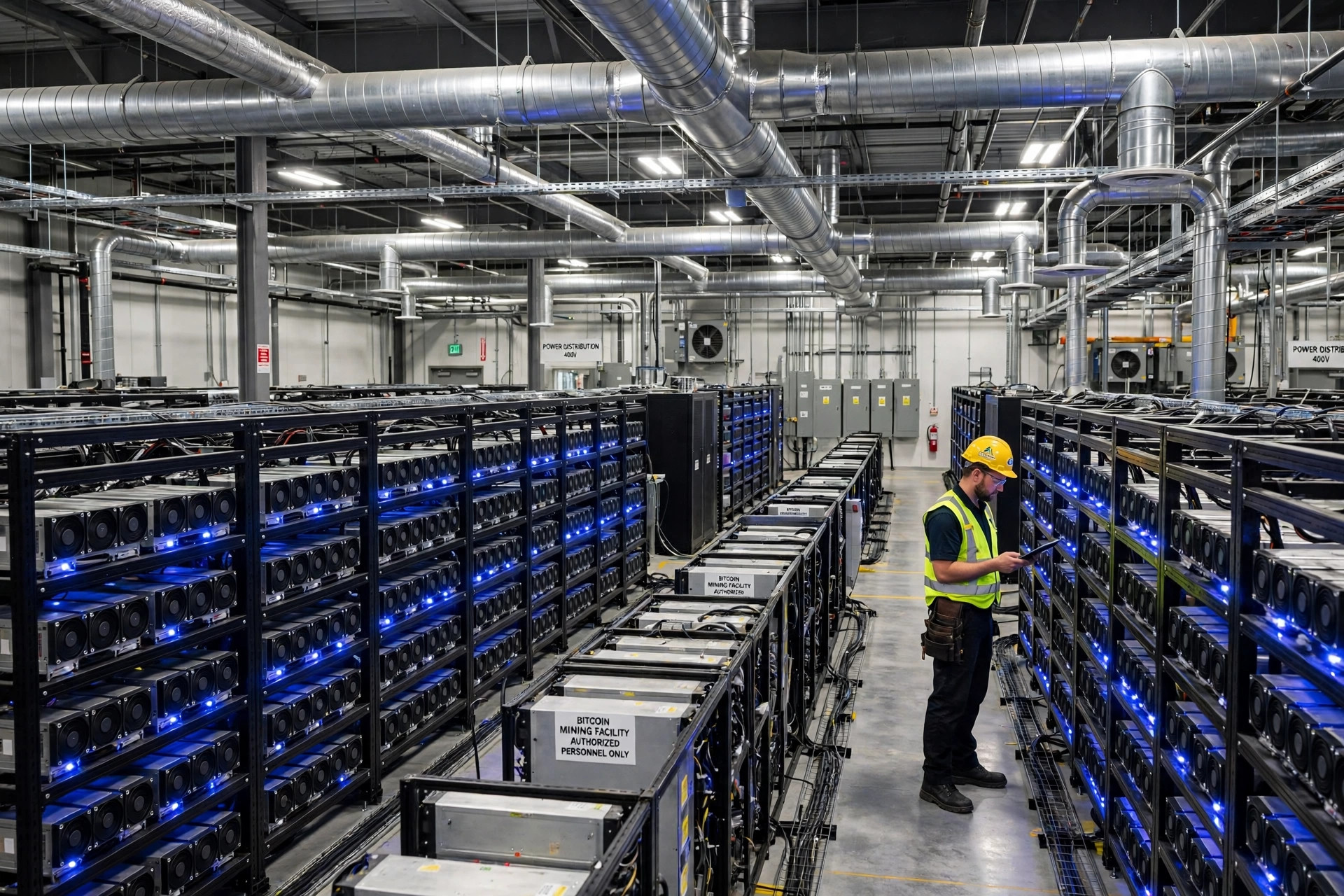
Bitcoin mining hosting means a colocation facility racks, powers, cools and monitors ASIC miners you own, charging an all-in rate per kilowatt-hour. In 2026, competitive US colocation runs $0.045–$0.085/kWh all-in, with lower rates in Paraguay, Iceland and the UAE — but the headline rate is only one line of the contract. The rate lock, the uptime SLA, the fee schedule and the exit clause decide whether a host protects your margin or quietly eats it. This guide prices the market, does the SLA math, and gives you the checklist to run before your hardware ships.
Bitcoin Mining Hosting 2026: What Colocation Actually Costs
Electricity is 75–85% of an ASIC miner's ongoing cost in 2026, so choosing a host is mostly choosing a power price. Colocation is almost universally priced per kilowatt-hour: the all-in rate covers electricity, cooling, rack space, basic monitoring and physical security, and you pay for what your miners actually draw. ASICs draw near-constant power 24/7, so metered billing fits the workload.
| Region | Typical all-in rate ($/kWh) | Power source | Why it is cheap |
|---|---|---|---|
| West Texas, USA | $0.045–$0.065 | Wind, natural gas, curtailment | Lowest base power costs |
| US competitive markets | $0.045–$0.085 | Mixed grid | Most established facilities |
| Quebec, Canada | $0.050–$0.070 | Hydroelectric | Renewable, cold-climate cooling |
| Iceland / Norway | $0.040–$0.060 | Geothermal, hydroelectric | Near-zero cooling costs |
| Paraguay | $0.035–$0.050 | Itaipu hydroelectric | Lowest global rates |
| UAE / Middle East | $0.035–$0.060 | Natural gas, solar hybrid | Low energy cost |
Rates are mid-2026 market ranges (Rax Data & Energy, August–September 2026). Published provider rates from October 2026 sit inside the same band: Simple Mining charges $0.065–$0.08/kWh all-in across 11 Iowa data centers, tiered by deployment size; Hamus Hosting in Norway lists from EUR 0.059/kWh; Digital Bridge Mining lists from $0.065/kWh with a 95% monthly uptime guarantee; Endless Mining lists $0.08/kWh all-inclusive plus a $25 setup fee. Beyond the rate, budget setup fees of $50–$200 per unit and minimum commitments of 6–24 months. Residential power at $0.12–$0.20/kWh is unprofitable for every current ASIC in 2026.
Fixed vs Pass-Through: How the Rate Is Actually Billed
A low headline rate means nothing if it floats. Get the billing model in writing first:
Fixed, pass-through, or layered
- Fixed rate: the $/kWh is locked for the contract term and the host absorbs market risk. This is the model to prefer — a rate locked for the life of the hardware is worth more than a slightly lower floating rate.
- Pass-through with documented tariff: you pay the actual wholesale rate plus a defined markup. Acceptable only if the tariff is documented and the markup is fixed in the contract.
- All-in vs layered: "all-in" should mean power, cooling, rack space, monitoring and security in one number. If the contract adds a management fee on top — a $15/month fee on a $0.07/kWh contract, for example — the effective rate is higher than the headline. Add every fee to the rate before you compare hosts.
Uptime SLAs: What 99% vs 99.9% Really Costs
Every reputable host advertises 99% uptime or better. The numbers look close together; the downtime is not:
| SLA | Downtime per year | Downtime per month |
|---|---|---|
| 99.9% | 8.76 hours | ~44 minutes |
| 99% | 87.6 hours | ~7.3 hours |
| 95% | 438 hours | ~36.5 hours |
At a mid-July 2026 hashprice of roughly $30 per PH/s per day (Hashrate Index), the gap between 99% and 99.9% uptime is 78.84 hours a year — about 3.3 days of hashing. For a 1 PH/s fleet that is roughly $99 of gross revenue a year; for a 10 PH/s fleet, roughly $985.
The remedy matters more than the number
The contract must state what credit you receive per hour of downtime beyond the SLA — typically a pro-rated hosting-fee credit, in aggressive contracts a pro-rated lost-revenue credit. Some hosts use precision billing instead: you pay only for actual hashing time, so downtime is credited without paperwork. Confirm whether the guarantee covers power only or power plus network, whether planned maintenance is scheduled and capped per month, and the minimum term and early-termination fee — most facilities lock 12-month agreements; some offer month-to-month at a premium.
Which Miners to Host: Breakeven Power by Model
Hosting only works if your hardware earns more than the rate costs. The breakeven electricity rate is the highest $/kWh at which a miner still generates positive revenue after power costs, and it moves with Bitcoin price and difficulty. Under August 2026 network conditions (BTC $63,000–$77,000, 878 EH/s), published breakevens were roughly:
| Model | Efficiency | Breakeven power price |
|---|---|---|
| Antminer S23 Hydro | 9.5 J/TH | ~$0.124/kWh |
| Antminer S21 XP | 13.5 J/TH | ~$0.088/kWh |
| Antminer S21 Pro | 15.0 J/TH | ~$0.075/kWh |
| Antminer S21 | 17.5 J/TH | ~$0.068/kWh |
| Whatsminer M60S | 18.5 J/TH | ~$0.060/kWh |
Industrial all-in hosting typically runs $0.065–$0.08/kWh in 2026, so anything above about $0.085/kWh sits near breakeven for most current-generation hardware. The efficiency of the miner you host decides how much headroom you have — these are the current MineForgeX models buyers host most:
| Model | Hashrate | Power | Efficiency | Price |
|---|---|---|---|---|
| Antminer S23 Hyd 3U | 1.16 PH/s | 11,020 W | 9.5 J/TH | $30,000 |
| Antminer S23 Hyd 580T | 580 TH/s | 5,510 W | 9.5 J/TH | $13,300 |
| Antminer S23e Hyd 2U | 865 TH/s | 8,650 W | 10.0 J/TH | $9,529 |
| Antminer S21 XP+ Hyd | 500 TH/s | 5,500 W | 11.0 J/TH | $9,500 |
| Canaan Avalon A16XP | 300 TH/s | 3,850 W | 12.8 J/TH | $5,000 |
| Antminer S21 Pro | 234 TH/s | 3,510 W | 15.0 J/TH | $3,490 |
| Whatsminer M60S+ | 210 TH/s | 3,570 W | 17.0 J/TH | $2,880 |
One compatibility check before you ship: hydro-cooled miners need a host with a liquid-cooling loop. A 20,000 W hydro rig cannot operate on an air-cooled rack, and most hosting sites need to configure the loop in advance. Confirm the cooling type in writing — air, hydro or immersion — for the exact model you are sending. Run the full profitability math in the Bitcoin mining profitability guide and the MineForgeX calculator before you commit to a rate.
The Due-Diligence Checklist Before You Ship
Run these eight checks before any hardware leaves your warehouse. If a provider hedges on any of them in writing before signature, treat that as the answer:
- Rate in writing: fixed for the term, or pass-through with a documented tariff and a fixed markup. No verbal rates.
- SLA remedy: the credit formula per hour of downtime beyond the SLA, and whether it covers power only or power plus network.
- Power redundancy: a redundant utility feed (N+1 preferred), online UPS covering network gear and controllers, and diesel generator capacity for at least 24 hours of full-fleet operation. Ask for the facility one-line diagram — a serious host shares it under NDA.
- Network: redundant 1 Gbps uplinks, DDoS mitigation in front of pool ports, and Stratum V2 support if you mine on a V2 pool.
- Full fee schedule: setup, management, maintenance and pool cuts disclosed before signing, not after. Add them to the headline rate.
- Contract flexibility: minimum term, early-termination fee, notice period, and whether you can pause or scale without losing your slot.
- Repairs and warranty: who fixes the machine, who pays, and whether third-party hosting affects the manufacturer warranty — that depends on the manufacturer's terms, so check them for your exact model.
- Proof, not promises: client references, a site visit or live video walkthrough, and a monitoring dashboard showing per-unit power draw and uptime.
Hosting vs Building Your Own Container
Hosting and self-hosting solve the same problem from opposite sides. Hosting buys cheap power, professional cooling and no capital expenditure — you pay per kWh and scale by shipping more units. Building your own container buys control: your power contract, your cooling design, your uptime, and no host's margin on top of the rate. The trade-off is capital: a container, electrical work, cooling plant and a power connection are a project, not a purchase. For most buyers the honest sequence is to host first, learn the real operating cost per PH/s, and only then price the container. The Bitcoin mining container price guide prices a 1 MW turnkey container — the right comparison point against a year of hosting fees at your quoted rate.
Frequently Asked Questions
How much does Bitcoin mining hosting cost in 2026?
Competitive US all-in colocation runs $0.045–$0.085/kWh, with published provider rates of $0.065–$0.08/kWh. Lower rates exist in Paraguay ($0.035–$0.050/kWh), Iceland and Norway ($0.040–$0.060/kWh) and the UAE ($0.035–$0.060/kWh). Add setup fees of $50–$200 per unit and confirm whether the rate is fixed or floating.
What uptime SLA should I expect from a mining host?
Reputable facilities quote 99% uptime or higher: 99.9% means 8.76 hours of downtime a year, 99% means 87.6 hours. What matters more is the remedy — the credit per hour of downtime beyond the SLA, and whether it covers power only or network too.
Does hosting void my miner warranty?
It depends on the manufacturer's terms for your exact model — third-party hosting may or may not affect warranty coverage. Check the warranty terms before shipping, and get the host's repair policy in writing: who fixes the machine, how fast, and who pays.
Can I host a hydro-cooled miner at any facility?
No. Hydro-cooled miners need a facility with a liquid-cooling loop configured for that model, and immersion miners need a tank. Hydro and immersion capacity must be confirmed in writing for the exact model before you ship, including coolant, flow rate and inlet temperature.
One clear next step: price your fleet at the hosting rate, not the headline. Take the model, its power draw and the quoted all-in rate, run the math in the calculator, and only ship when the breakeven leaves real headroom — then get the rate, the SLA remedy and the exit clause in writing before the first unit leaves your warehouse.
Discuss this with the MineForgeX team
Questions about the hardware, cooling, or deployment in this article? Request a quote for your facility.
Consult Team →