Market Economics
Bitcoin Mining Profitability 2026 Guide
Bitcoin mining profitability in 2026: hashprice, power costs and payback math for ten current miners at catalog prices, with a worked example. Read the guide.
#Profitability #Hashprice #Hardware
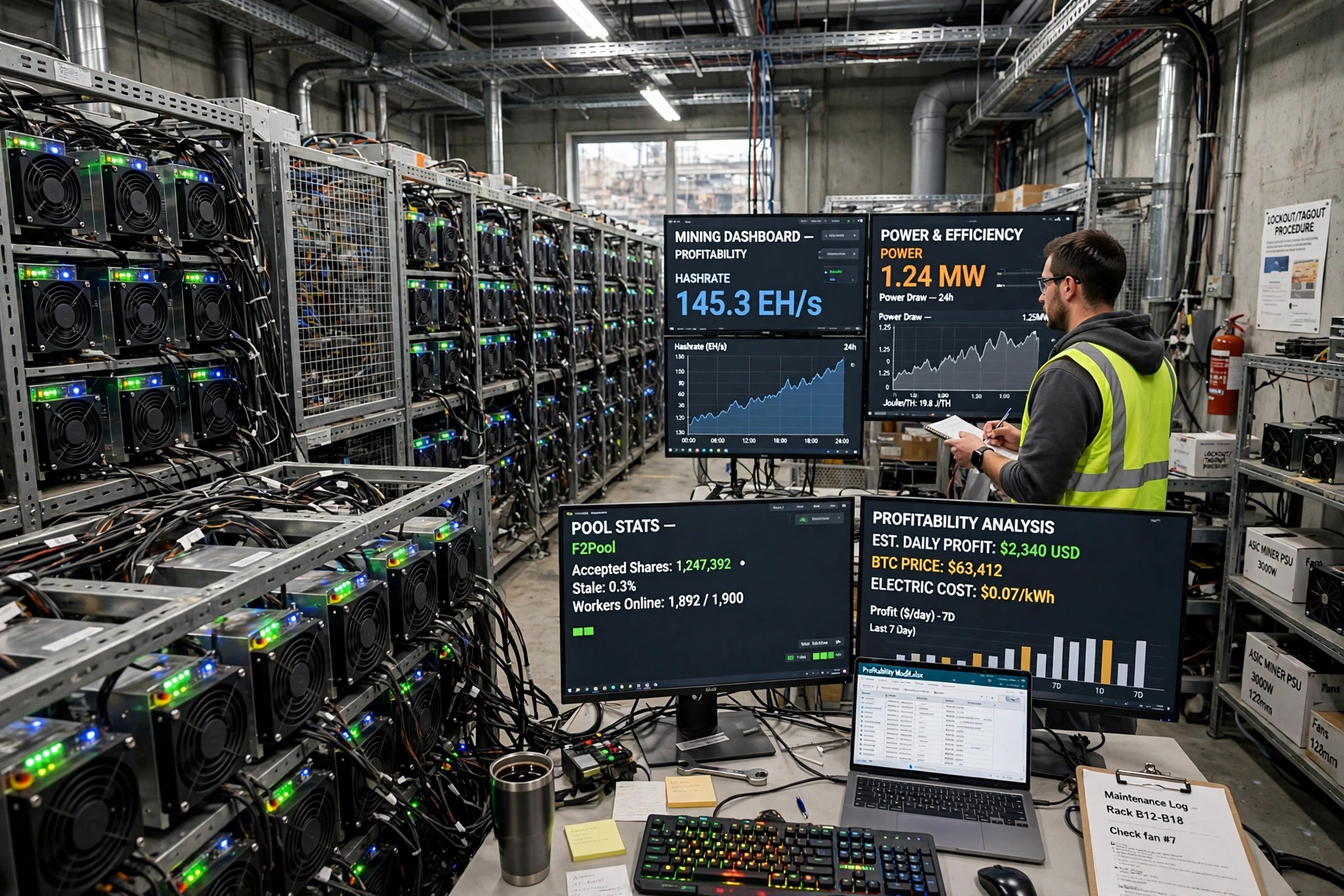
Bitcoin mining profitability in 2026 comes down to one subtraction: daily revenue minus daily power cost. Revenue is your hashrate times the hashprice — about $33.09 per PH per day in the November 2026 snapshot this guide uses. Power cost is your miner's wattage times 24 hours times your electricity price. At $0.08 per kWh, an Antminer S23e Hyd 2U (865 TH/s, $9,529) nets about $12.01 a day and pays for itself in roughly 793 days — if the hashprice held flat, which it never does.
What Bitcoin Mining Profitability Means in 2026
Hashprice is the revenue a unit of hashrate earns: dollars per petahash per day. It is the Bitcoin price, the block subsidy (3.125 BTC since the 2024 halving) and the network difficulty compressed into one number, and it moves every day. The November 2026 snapshot used across this guide is about $33.09 per PH per day — a Simple Mining reading for the month. Treat every payback figure that follows as a sizing exercise on that snapshot, not a forecast: if the Bitcoin price halves or difficulty doubles, the revenue column halves with it.
Two things the subtraction leaves out, and you must add them back before you order. First, pool fees — typically 1–3% of revenue — plus facility overhead, cooling-plant energy and downtime; the power costs below are the miner's own watts only. Second, the purchase price: profitability is a daily margin, payback is that margin against the cheque. A miner can be profitable every day and still take years to repay its price.
The Three Numbers That Decide Profitability
Every miner in the catalog is described by three numbers, and the whole buying decision is how they combine at your power price.
Hashrate: your share of the network
Hashrate is how many terahashes per second the machine computes — 865 TH/s for the S23e Hyd 2U, 1,350 TH/s for the Whatsminer M79S, 234 TH/s for the Antminer S21 Pro. Daily revenue is hashrate in PH times hashprice: 0.865 PH × $33.09 = $28.62 a day for the S23e Hyd 2U; 1.35 PH × $33.09 = $44.67 a day for the M79S. Bigger hashrate means bigger gross revenue — but also, usually, a bigger power draw, which is why hashrate alone never decides a purchase.
Efficiency: joules per terahash
Efficiency is watts per terahash — J/TH — and it decides how much of that revenue survives the power bill. The current fleet runs from 8.9 J/TH (Antminer S23 XP Hyd) to 22.0 J/TH (Whatsminer M53S++ Hydro and M56S++ Immersion). At the same hashrate, a 9.5 J/TH machine burns roughly half the power of a 19 J/TH machine and keeps roughly twice the margin. Efficiency also sets the break-even power price: daily gross revenue divided by daily kilowatt-hours. For the S23e Hyd 2U that is $28.62 ÷ 207.6 kWh = about $0.138 per kWh; for the S21 Pro it is $7.74 ÷ 84.24 kWh = about $0.092 per kWh — a 5-cent gap in what each machine can afford to pay for power.
Power price: the number you control
Power price is the one input you choose, and it moves the answer more than any machine choice. At $0.05 per kWh the S21 Pro nets $3.53 a day; at $0.08 it nets $1.00; at $0.10 it loses $0.68 a day. The same machine, three different businesses, decided entirely by the power contract. Before comparing miners, pin down your all-in power price — energy, demand charges and delivery — and run every candidate in the MineForgeX calculator at that exact figure. A $0.02 difference in power price is worth more than a generation of hardware.
Bitcoin Mining Profitability by Miner: Ten Current Machines
The table below runs the same snapshot — $33.09 per PH per day, $0.08 per kWh — across ten current catalog miners at MineForgeX list prices. Payback is list price divided by daily net revenue, assuming the snapshot held flat; it will not, so read payback as a ranking, not a promise.
| Model | Hashrate | Power | Efficiency | Price | Price / TH | Daily net @ $0.08/kWh | Payback |
|---|---|---|---|---|---|---|---|
| Antminer S23e Hyd 2U | 865 TH/s | 8,650 W | 10.0 J/TH | $9,529 | $11.02 | $12.01 | ~793 days |
| Bitdeer SealMiner A4 Ultra Hydro | 886 TH/s | 8,373 W | 9.45 J/TH | $10,600 | $11.96 | $13.24 | ~801 days |
| Antminer S23 Hyd | 580 TH/s | 5,510 W | 9.5 J/TH | $13,300 | $22.93 | $8.61 | ~1,544 days |
| Antminer S23 XP Hyd | 600 TH/s | 5,340 W | 8.9 J/TH | $15,300 | $25.50 | $9.60 | ~1,594 days |
| Whatsminer M79S | 1,350 TH/s | 20,000 W | 14.8 J/TH | $12,100 | $8.96 | $6.27 | ~1,929 days |
| Whatsminer M7AS+ | 540 TH/s | 6,750 W | 12.5 J/TH | $7,000 | $12.96 | $4.91 | ~1,426 days |
| Antminer S21e XP Hydro 3U | 860 TH/s | 11,180 W | 13.0 J/TH | $8,179 | $9.51 | $6.99 | ~1,170 days |
| Antminer S21 XP Hydro | 473 TH/s | 5,676 W | 12.0 J/TH | $8,450 | $17.86 | $4.75 | ~1,778 days |
| Antminer S21 Pro | 234 TH/s | 3,510 W | 15.0 J/TH | $3,490 | $14.91 | $1.00 | ~3,477 days |
| Whatsminer M60S+ | 210 TH/s | 3,570 W | 17.0 J/TH | $2,880 | $13.71 | $0.09 | No payback |
The cheapest hashrate is not the fastest payback
The M79S is the cheapest hashrate in the catalog at $8.96 per TH — 1,350 TH/s for $12,100 — and it still takes about 1,929 days to pay back at $0.08 per kWh, because 20,000 W at 14.8 J/TH eats $38.40 of its $44.67 daily gross. Price per TH measures the cheque; payback measures the business. The S23e Hyd 2U costs more per terahash ($11.02) and pays back in less than half the time (793 days). Buy on payback, not on $/TH.
Why the S23e Hyd 2U leads the table
The S23e Hyd 2U is the fastest payback in the table at 793 days, just ahead of the Bitdeer SealMiner A4 Ultra Hydro at 801 days — and the A4 Ultra Hydro actually nets more per day ($13.24 vs $12.01), but costs $1,071 more per unit, so the S23e Hyd 2U wins on the ratio that matters. The catch is infrastructure: both are hydro-cooled, 380–415V three-phase machines that need a coolant loop and a dry cooler, so they are facility purchases, not home miners. See the full specification on the Antminer S23e Hyd 2U product page before sizing a loop. And note the bottom of the table: the Whatsminer M60S+ nets $0.09 a day at $0.08 per kWh — effectively no payback at that power price, however cheap the unit looks.
Power Price Changes Everything
Hold the machine fixed and move the power price, and the business changes completely. The S23e Hyd 2U at four power prices:
| Power price | Daily power cost | Daily net revenue | Payback |
|---|---|---|---|
| $0.05 / kWh | $10.38 | $18.24 | ~522 days |
| $0.08 / kWh | $16.61 | $12.01 | ~793 days |
| $0.10 / kWh | $20.76 | $7.86 | ~1,212 days |
| $0.12 / kWh | $24.91 | $3.71 | ~2,568 days |
Three cents of power price — $0.05 to $0.08 — costs the S23e Hyd 2U $6.23 a day and adds 271 days to payback. The same three cents rescues the air-cooled fleet: at $0.05 the S21 Pro nets $3.53 a day (988-day payback) and the M60S+ nets $2.66 a day (1,081 days), both viable businesses. At $0.08 both are marginal; at $0.10 the M60S+ is underwater. Cheap power makes ordinary hardware pay; expensive power leaves only the efficient hydro fleet standing. The break-even prices say it in one number per machine — S23 XP Hyd about $0.155, A4 Ultra Hydro about $0.146, S23 Hyd about $0.145, S23e Hyd 2U about $0.138, S21 Pro about $0.092, M60S+ about $0.081. Above a machine's break-even, it loses money every day it runs.
Who Should Buy Now — and Who Should Wait
This guide is for data centre operators and fleet owners with power at or below $0.08 per kWh and hydro or immersion infrastructure in place — the S23e Hyd 2U and A4 Ultra Hydro are the buys — and for buyers on $0.05 power, where the air-cooled S21 Pro class also pays. It is not for buyers on $0.10-plus power running 15+ J/TH air-cooled hardware, for home miners without three-phase power and ventilation, or for anyone who needs a guaranteed return: hashprice, difficulty and the Bitcoin price all move.
One clear next step: browse the full catalog, pick the machine whose break-even sits comfortably above your power price, then request a quote stating the quantity, your power price, your cooling status and the destination. MineForgeX confirms allocation, cooler sizing and the landed DDP price in writing.
Frequently Asked Questions
How is bitcoin mining profitability calculated?
Daily revenue is hashrate in petahash times the hashprice in dollars per PH per day. Daily power cost is the miner's power in kilowatts times 24 hours times your electricity price. Subtract the second from the first for daily net revenue, and divide the purchase price by daily net revenue for the payback time. All four inputs must be real — rated specs, a current hashprice snapshot and your all-in power price — or the answer is fiction.
What is hashprice, and what value does this guide use?
Hashprice is the revenue one petahash of hashrate earns per day, set by the Bitcoin price, the 3.125 BTC block subsidy and network difficulty. This guide uses about $33.09 per PH per day, a Simple Mining snapshot for November 2026. It moves daily, so treat every payback figure here as a sizing exercise on that snapshot, not a forecast.
What power price makes Bitcoin mining profitable in 2026?
It depends on the machine's efficiency. The best hydro miners (8.9–9.5 J/TH) break even near $0.145–$0.155 per kWh; the S21 Pro class (15.0 J/TH) near $0.092; the M60S+ (17.0 J/TH) near $0.081. Below $0.08 per kWh most of the current fleet clears its power bill; above $0.10 only the efficient hydro fleet does.
Which miner pays back fastest at $0.08 per kWh?
The Antminer S23e Hyd 2U, at about 793 days on the November 2026 snapshot — just ahead of the Bitdeer SealMiner A4 Ultra Hydro at about 801 days. Both need hydro infrastructure and 380–415V three-phase power.
Discuss this with the MineForgeX team
Questions about the hardware, cooling, or deployment in this article? Request a quote for your facility.
Consult Team →