Enterprise Guide
Bitcoin Mining Heat Reuse Guide 2026
Bitcoin mining heat reuse turns waste heat into hot water for buildings and networks — what it is worth, and what the plumbing costs. Request a quote today.
#Heat Reuse #Hydro Cooling #Sustainability
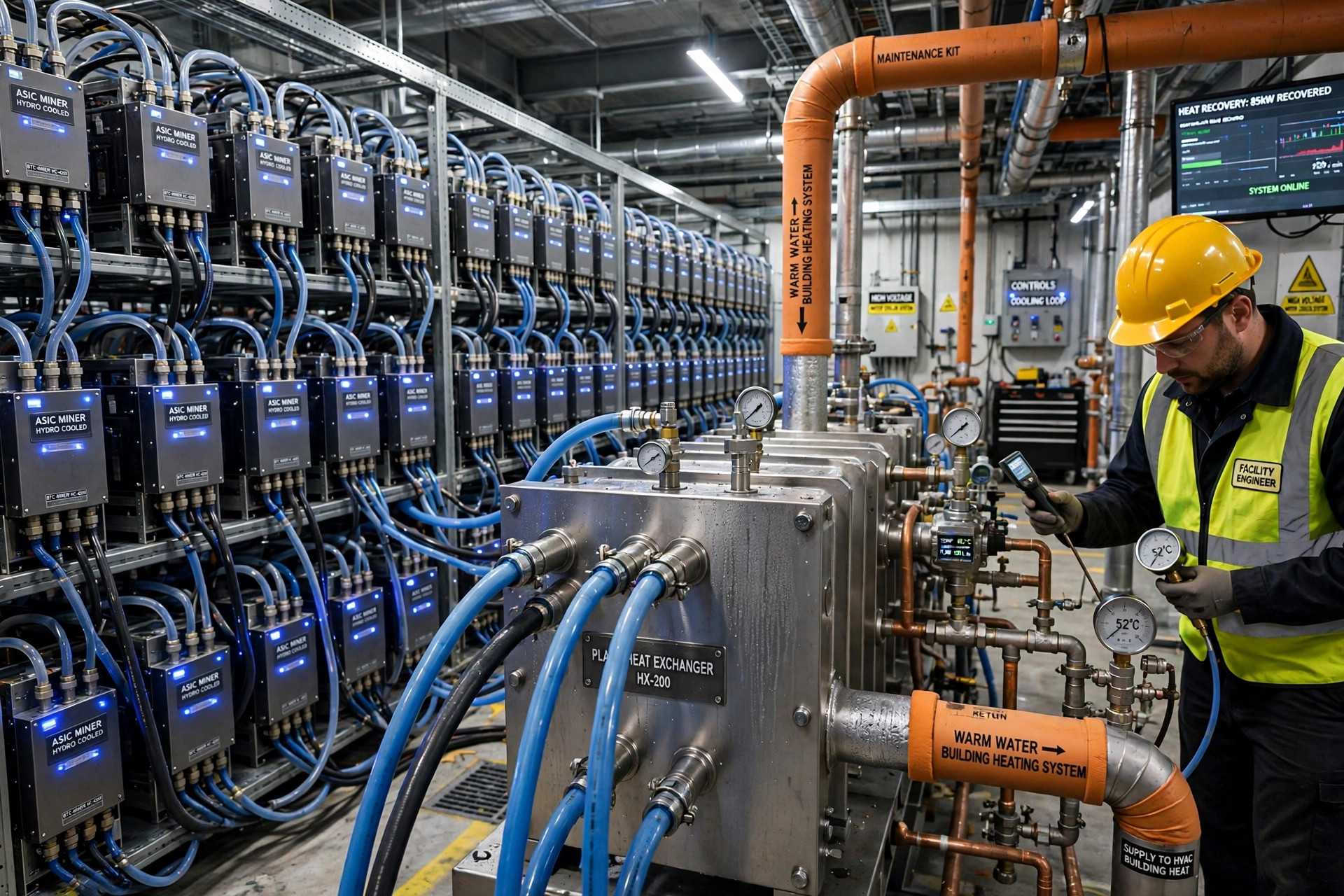
Bitcoin mining heat reuse means capturing the heat a miner produces and putting it to work instead of throwing it away. Nearly every watt a miner draws becomes heat, so a hydro-cooled miner is really a water heater that also mines Bitcoin: its coolant leaves warm and can heat a building, a greenhouse or a district network. Bitmain's ANTRACK AR1902 pushes that water to 80°C, hot enough for standard radiators. This guide explains what the heat is worth, which water temperatures unlock which uses, and what the plumbing costs — from real catalog specs.
A Bitcoin Miner Is a Heater That Also Mines
A miner's power draw is its heat output: a unit drawing 5,510 W rejects 5.51 kW of heat, 24 hours a day. Air-cooled miners dump that heat as hot air, which is hard to collect and harder to pipe anywhere useful. Hydro-cooled miners dump it as warm water, which a pipe can carry to a radiator, a greenhouse or a heat exchanger. That is the whole case for heat reuse — the heat is already paid for, and water is the only practical way to move it.
One kilowatt of continuous heat is 8.76 MWh of thermal energy a year, so even a single hydro miner is a serious heater:
| Model | Hashrate | Power | Efficiency | Heat rejected | Heat per year | Price |
|---|---|---|---|---|---|---|
| Antminer S23 Hyd 3U | 1.16 PH/s | 11,020 W | 9.5 J/TH | 11.02 kW | 96.5 MWh | $30,000 |
| Antminer S23 XP Hyd | 600 TH/s | 5,340 W | 8.9 J/TH | 5.34 kW | 46.8 MWh | $15,300 |
| Antminer S23e Hyd 2U | 865 TH/s | 8,650 W | 10.0 J/TH | 8.65 kW | 75.8 MWh | $9,529 |
| Antminer S21 XP+ Hyd | 500 TH/s | 5,500 W | 11.0 J/TH | 5.50 kW | 48.2 MWh | $9,500 |
| Whatsminer M7DS | 680 TH/s | 9,200 W | 13.5 J/TH | 9.20 kW | 80.6 MWh | $7,599 |
| Whatsminer M63S+ Hydro | 450 TH/s | 7,650 W | 17.0 J/TH | 7.65 kW | 67.0 MWh | $5,900 |
An Antminer S23 Hyd 3U alone rejects 96.5 MWh of heat a year; ten reject 965 MWh.
Water Temperature Decides What the Heat Is Worth
Heat has a temperature, and the temperature decides the use. Water at 50°C suits underfloor heating, greenhouses, swimming pools and preheating domestic hot water. Water at 60–70°C, the range direct hydro cooling typically produces, starts to work with standard radiators. Water at 80°C feeds a district heating network or industrial process heat directly, with no boost.
A heat pump can lift 50°C water to radiator temperature, but it draws power of its own — the lift is only worth it when the heat has a paying use at the other end. First question before buying: what temperature does your heat user need, and does your miner deliver it?
The 50°C and 80°C split
Bitmain's own numbers make the split concrete. The ANTRACK AR1901 leaves water at up to 50°C — low-temperature uses, or a heat pump. The AR1902 leaves water at up to 80°C — radiators and district heating without a boost. Same miners, different hydraulics — the $6,000 gap is the cost of the high-temperature output.
Bitmain ANTRACK AR1901 and AR1902: Heat Reuse in a Box
On November 13, 2026 Bitmain brought back its ANTRACK hydro-cooling packages for a limited time. Each package is one ANTRACK cabinet plus four Antminer S19 XP+ Hyd miners, sold at a promotional $1 per TH/s for the miners. The cabinet does the heat recovery: the miners' coolant runs through its heat exchanger, and warm water comes out the other side. Bitmain lists shipping within 20 business days after payment, while the limited stock lasts.
| Package | Cabinet | Miners | Hashrate | Package power | Leaving water | Package price |
|---|---|---|---|---|---|---|
| ANTRACK AR1901 | AR21 ($2,888) | 4× S19 XP+ Hyd | 1,172 TH/s | 24 kW | Up to 50°C | $4,060 |
| ANTRACK AR1902 | AR22 ($8,888) | 4× S19 XP+ Hyd | 1,172 TH/s | 32 kW | Up to 80°C | $10,060 |
The arithmetic checks out: 4 × 293 TH/s is 1,172 TH/s, and $1,172 of miners plus $2,888 (AR21) is $4,060; plus $8,888 (AR22) is $10,060.
Be clear-eyed about what the package is. The S19 XP+ Hyd runs 293 TH/s at 5,567 W and 19 J/TH — last-generation efficiency, roughly double the joules per terahash of an S23 XP Hyd at 8.9 J/TH. Nobody buys an ANTRACK for the hashrate. Its value is the heat: 24 kW of continuous 50°C water from the AR1901, or 32 kW of 80°C water from the AR1902. MineForgeX does not stock ANTRACK — Bitmain sells it direct — but the numbers here are Bitmain's own.
Heat Reuse With Current-Generation Hydro Miners
An ANTRACK is not the only route. Any hydro miner in the catalog rejects its heat as warm water, and the current generation does it at half the electricity per terahash of the S19 XP+ Hyd. The Bitcoin miner cooling guide covers the cooling side in detail.
A hydro fleet needs one of two endings for its warm water: a heat user, or a dry cooler that dumps the heat to the air. The dry cooler is the fallback every site should price — the 120 kW unit costs $7,450 and draws 2,200 W, the 240 kW adiabatic unit costs $13,900 and draws 4,200 W. If no heat user exists, the dry cooler is the honest cost of rejecting the heat. If a heat user does exist, the dry cooler becomes the backup for summer, when nobody wants heating.
At container scale the same logic applies: the 40 ft hydro container is rated for 1.6 MW of miners, so 1.6 MW of heat to place — a district network or greenhouse complex, not a single house.
What to Do With the Heat: Real Projects
Heat reuse is not a whiteboard idea. Marathon Digital (MARA) launched a 2 MW pilot in the Satakunta region of Finland in June 2024, feeding mining heat into a district heating network for a community of about 11,000 residents. A July 2025 update put Satakunta at about 3.5 MW of heat at 55–78°C, and a second site in Seinajoki at about 1 MW from miners plus 0.25 MW from heat pumps at 50–60°C. Both sites were connected to existing networks in under 30 days, and in Seinajoki the mining heat replaced peat, oil and wood.
In North Vancouver, MintGreen partnered with the city-owned utility Lonsdale Energy in March 2022 to add Bitcoin mining heat to a hydronic district energy system serving about 100 residential and commercial buildings. The pattern is the same in every case: the heat user sits next to the miners, and the pipes are short.
That is the rule: heat is only worth money if a user sits next to the miners, and summer heat has no buyer in most climates — the heating season is when the heat pays, and the rest of the year it goes to the dry cooler.
The Economics, Honestly
One kilowatt of continuous heat is 8.76 MWh of thermal energy a year. An AR1901 package at 24 kW rejects about 210 MWh a year (24 × 8,760 hours); an AR1902 at 32 kW rejects about 280 MWh a year. If that heat displaces heating that would otherwise cost $0.08/kWh, the displaced value is about $16,819 a year for the AR1901 and about $22,426 for the AR1902.
Those figures are arithmetic at a stated heating cost, not a forecast, and they assume every kilowatt-hour of heat is actually used. Three conditions decide whether the real number lands anywhere near them: a heat user next door (no user, no value — the heat goes to the dry cooler instead); a heating season (heat pays in winter; in summer it is a disposal problem); and the plumbing paid for (a plate heat exchanger, pumps, piping, controls and possibly a heat pump are real capital costs, on top of the miners and the dry cooler).
Heat reuse is best understood as a discount on the power bill, not as income. It does not make an unprofitable miner profitable — the mining revenue still decides that, and the Bitcoin mining power supply guide runs the power-side numbers at your own $/kWh. What heat reuse does is turn a cost — rejecting heat — into something a neighbour will pay for, or into heat you would otherwise have bought.
Who this guide is for: operators with hydro miners and a building, greenhouse or network next door. Who it is not for: air-cooled sites with no warm-water loop, and anyone whose heat has nowhere to go — price the dry cooler and move on.
One clear next step: price the hydro fleet and the dry cooler together, bring the heat user to the quote — the temperature they need and the kilowatts they can take — and request a quote with the model, quantity and your power price.
Frequently Asked Questions
How hot is the water coming out of a hydro miner?
Hydro miners in the catalog run coolant up to 50°C, and direct hydro cooling produces 60–70°C water. Bitmain's ANTRACK AR1901 leaves water at up to 50°C and the AR1902 at up to 80°C. The temperature decides the use: 50°C suits underfloor heating and greenhouses, 80°C feeds radiators and district heating directly.
Can mining heat warm a house?
Yes, with plumbing between the miner and the house. One Antminer S23 Hyd 3U rejects 11.02 kW of heat — 96.5 MWh a year. It needs a hydro miner, a heat exchanger, piping and a use for the heat year-round. Hot air from air-cooled miners is far harder to use, which is why heat reuse is a hydro-miner story.
Does heat reuse make mining profitable?
No. Heat reuse offsets heating cost; it does not create mining revenue. At $0.08/kWh of displaced heating, a 24 kW package's heat is worth about $16,819 a year in arithmetic — but only if every kilowatt-hour is used, and only after paying for the plumbing. Treat the heat as a discount on power, not as income.
What does the heat-reuse plumbing cost?
It varies by site: a plate heat exchanger, circulation pumps, insulated piping, controls and possibly a heat pump. There is no single price to quote. Price the dry cooler as the fallback — $7,450 for the 120 kW unit, $13,900 for the 240 kW adiabatic unit — and get a quote that includes the heat-recovery hardware with the miners.
Discuss this with the MineForgeX team
Questions about the hardware, cooling, or deployment in this article? Request a quote for your facility.
Consult Team →