Enterprise Guide
Bitcoin Miner Warranty Guide 2026
Bitcoin miner warranty runs 6 or 12 months by model — what it covers, what voids it, and how to claim. Check yours before you buy. Request a quote today.
#Warranty #ASIC Miners #Buyer Guide
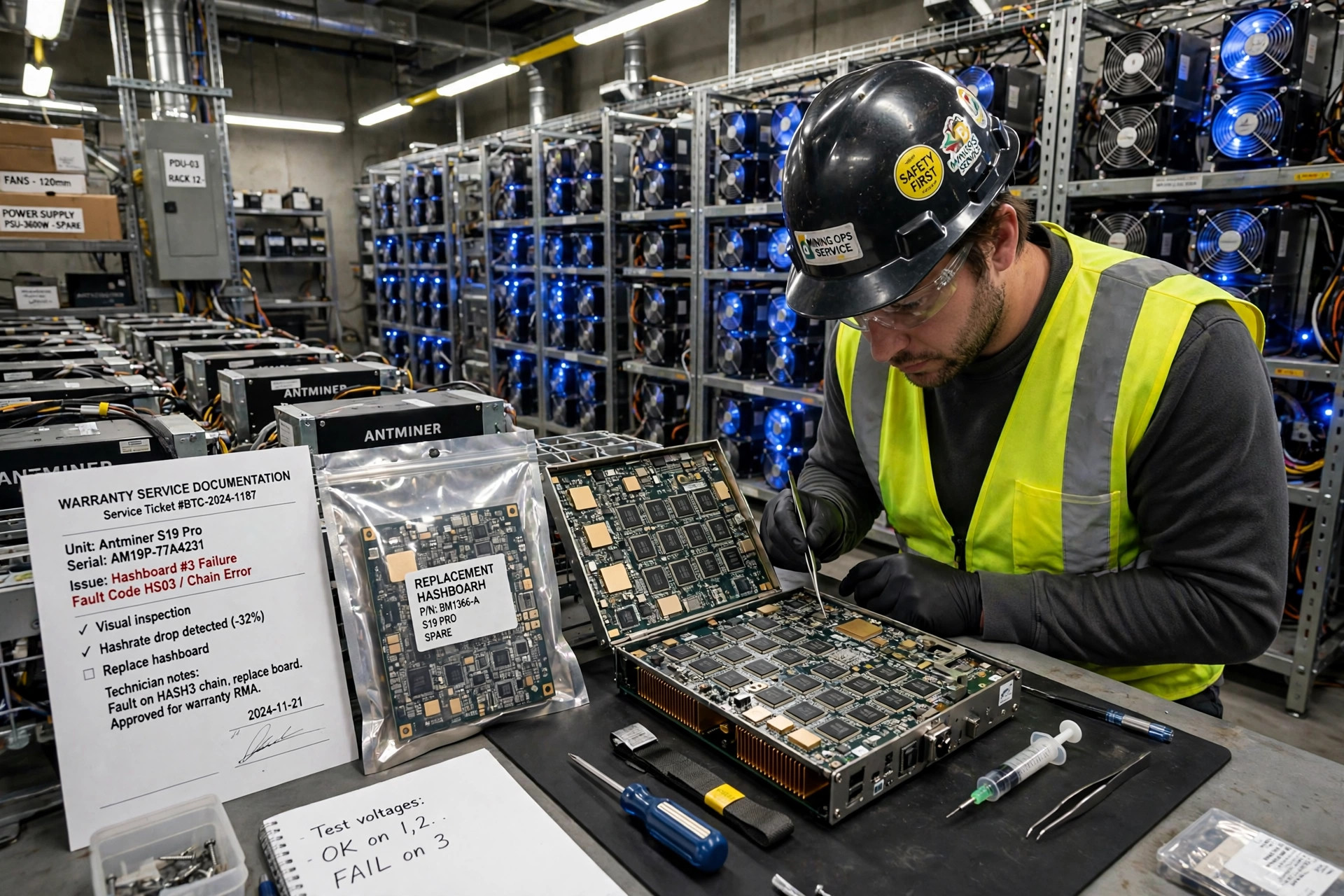
A Bitcoin miner warranty is the manufacturer's promise to repair or replace a miner that fails in normal use — and the length is not the same for every model. In the MineForgeX catalog, 94 of 126 products carry 12 months, 19 carry 6, and infrastructure carries 24 to 60. What the warranty covers, what voids it, and who handles the claim matter more than the number of months. This guide uses the real catalog numbers so you can check your model before you pay.
What a Bitcoin Miner Warranty Actually Covers
A manufacturer warranty covers defects in materials and workmanship: a hashboard that stops hashing, a control board that will not boot, a power supply that dies, a fan that seizes. Parts and labour are covered, and the miner is repaired or the failed part replaced. A unit that arrives dead is covered too — and that is the claim to make on day one, not month six.
What a warranty does not cover is just as important. Return freight is usually the buyer's cost, and on a 15 kg miner shipped internationally that is real money. Consumables are excluded: fans wear out, and filters and thermal paste are maintenance, not defects. Damage from the buyer's own handling — a dropped unit, a flooded room, a power surge — is excluded. A warranty is the manufacturer's promise, not the seller's: the seller files the claim, the manufacturer decides it.
Check the product page before you buy: every product in the MineForgeX catalog lists its warranty in months, the manufacturer's term for that exact model.
Bitcoin Miner Warranty Lengths: 6 Months vs 12 Months
Most new Bitcoin miners carry 12 months. In the MineForgeX catalog, 94 of 126 products — about 75% — carry a 12-month warranty, including the Antminer S21 Pro (234 TH/s, 3,510 W, 15.0 J/TH, $2,949) and the Whatsminer M60S+ (210 TH/s, 3,570 W, 17.0 J/TH, $2,149). Twelve months of continuous operation is 8,760 hours; six months is 4,380.
Nineteen models carry 6 months instead — older-generation Whatsminers, small IceRiver and Goldshell home miners, the Antminer L7 and the pre-order X9:
| Model | Hashrate | Price | Warranty |
|---|---|---|---|
| Antminer L7 | 9.5 GH/s | $1,890 | 6 months |
| Whatsminer M50S++ | 150 TH/s | $1,690 | 6 months |
| Whatsminer M50S+ | 142 TH/s | $1,490 | 6 months |
| Whatsminer M53S++ Hydro | 320 TH/s | $3,900 | 6 months |
| Whatsminer M56S++ Immersion | 248 TH/s | $3,300 | 6 months |
| Whatsminer M50 | 120 TH/s | $1,090 | 6 months |
| Whatsminer M53 Hydro | 238 TH/s | $2,400 | 6 months |
| Whatsminer M56S Immersion | 212 TH/s | $2,600 | 6 months |
| IceRiver KS5M | 15 TH/s | $2,490 | 6 months |
| IceRiver KS5L | 12 TH/s | $1,990 | 6 months |
| IceRiver AL0 | 400 GH/s | $249 | 6 months |
| IceRiver KS3M | 6 TH/s | $890 | 6 months |
| IceRiver KS0 Ultra | 400 GH/s | $249 | 6 months |
| IceRiver KS0 Pro | 200 GH/s x2 | $149 | 6 months |
| IceRiver RX0 | 260 GH/s x2 | $349 | 6 months |
| Goldshell AL-BOX II | 720 GH/s | $449 | 6 months |
| Goldshell KA-BOX Pro | 1.6 TH/s | $389 | 6 months |
| Goldshell Mini-DOGE III | 650 MH/s | $549 | 6 months |
| Antminer X9 | 1 MH/s | $5,370 | 6 months |
A shorter warranty is not a defect — it is the manufacturer's term for that model, usually because the model is older or built to a lower price. What matters is knowing it before you pay: a 6-month warranty on a $1,490 M50S+ is a different risk calculation than 12 months on a $2,949 S21 Pro, and a listing that promises 12 months on a 6-month model is wrong.
Infrastructure carries longer terms, because it is built to last longer and fails less often:
| Product | Warranty | Price |
|---|---|---|
| ForgeTank 2 / 4 / 8 immersion tanks | 24 months | $2,190 / $3,490 / $5,900 |
| 120 kW dry cooler | 24 months | $7,450 |
| 240 kW adiabatic dry cooler | 24 months | $13,900 |
| Quick-disconnect hose kit | 24 months | $520 |
| 40 ft air-cooled container | 24 months | $46,000 |
| ForgeTank 24 enterprise immersion system | 36 months | $14,800 |
| 40 ft hydro container | 36 months | $89,000 |
| 20 ft immersion container | 36 months | $62,000 |
| Enterprise 3-phase metered PDU | 36 months | $1,190 |
| Synthetic dielectric coolant (200 L / 1,000 L) | 60 months | $1,290 / $5,400 |
What Voids a Bitcoin Miner Warranty
Most warranty refusals come from the same short list, and every item on it is avoidable.
- Running past the rated power. Overclocking beyond rated wattage, or feeding the wrong voltage, is the most common exclusion — the hashboards and power supply are sized for the rated power.
- Third-party firmware. Custom firmware exists — BiXBiT released firmware for Antminer S21 and S19 series on October 29, 2026 — and flashing it can void the warranty. If the warranty matters to you, run the stock firmware for its full term.
- Opening the case or unauthorised repair. Breaking the warranty seal, swapping a hashboard yourself, or letting an unauthorised shop open the unit gives the manufacturer grounds to refuse the claim.
- Wrong cooling. Running a hydro miner dry, an immersion miner in the wrong fluid, or any miner with blocked airflow or failed fans is misuse, not a defect. Filters and fluid levels are the operator's job — the Bitcoin mining farm maintenance guide covers the routine.
- Dust, moisture and physical damage. A miner dropped in transit by the buyer, flooded, or run in a dusty room without filtration is not a manufacturing defect — photograph the unit on arrival so transit damage is provable.
A miner runs 24 hours a day at full load for its whole life, and the manufacturer prices the warranty on the assumption that it runs inside its ratings. Stay inside them and the warranty stands.
How to Claim a Miner Warranty: The RMA Process
A warranty claim — an RMA, return merchandise authorisation — follows the same steps everywhere.
- Document the fault. Note the serial number, the error in the logs, and the behaviour: which hashboard, temperatures, fan speeds, when it started. Take photos and a short video — a claim with evidence moves faster than a claim with a sentence.
- Contact the seller the same day. The seller, not the manufacturer, is your point of contact — give them the serial number, the invoice and the evidence. For a dead-on-arrival unit, report it immediately; DOA claims have the shortest window.
- Diagnosis. The seller or manufacturer will usually ask for logs first and may diagnose remotely — many faults are a cable, a firmware setting or a power issue, not a dead board.
- Ship the failed part or the unit. Small parts — a control board, a fan, a power supply — usually ship alone; a dead hashboard may mean shipping the whole miner. Pack it as it arrived — damage in return transit is your cost.
- Repair or replacement. The manufacturer repairs the unit or sends a replacement part. Turnaround varies from days to weeks — ask for the estimate when you file, and plan your fleet around it.
Two questions to ask before you buy, not after a failure: who handles the claim — the seller or you, direct with the manufacturer — and who pays the return freight. Get the answers in writing, on the order.
Warranty vs Seller Guarantees: What MineForgeX Adds
A manufacturer warranty and a seller's guarantees are different things, and a buyer needs both. The warranty is the manufacturer's term for the model — 12 months for most miners, 6 for the nineteen above, longer for infrastructure — and it cannot be extended by the seller or cover freight.
What the seller adds is what you deal with before the warranty ever matters: video QC of your exact unit before it ships, so a dead board is caught at the warehouse, not at your site; insured DDP delivery, so freight and import duty are handled and the unit is covered in transit; and a seller who files the claim for you. None of that replaces the warranty — it is the service around it. When a listing quotes a warranty, check it against the product page for that exact model; if the two disagree, the product page is the one to believe.
Bitcoin Miner Warranty Checklist Before You Pay
- Check the warranty months on the product page for your exact model — 12 months for most miners, 6 for the nineteen listed above.
- Confirm in writing who files the claim and who pays freight.
- Keep the invoice and serial number; a claim without either is slow.
- Photograph the unit and its serial label on arrival.
- Budget for return freight on at least one unit — the warranty cost nobody quotes.
- For a fleet, hold one spare power supply and, if the budget allows, one spare hashboard — a warranty repair takes weeks and a spare keeps the rack hashing.
- Run stock firmware and stay inside the rated power and voltage for the full warranty term.
Who this guide is for: any buyer spending four figures on a miner, and any fleet operator for whom one dead hashboard is a scheduling problem. Who it is not for: buyers of the smallest home miners, where the warranty is 6 months, the price is under $500, and shipping a claim can cost more than the unit — for those, the checklist still applies, but the maths is different.
One clear next step: open the product page for the model you want, check the warranty months, and request a quote — model, quantity and power price — and ask who files the claim and who pays the freight.
Frequently Asked Questions
How long is a Bitcoin miner warranty?
Most new Bitcoin miners carry a 12-month manufacturer warranty. In the MineForgeX catalog, 94 of 126 products carry 12 months and 19 carry 6 — mostly older Whatsminers and small IceRiver and Goldshell home miners — while infrastructure carries 24 to 60 months. Check the warranty months on the product page for your exact model.
Does overclocking void a miner warranty?
Running a miner past its rated power or voltage is a common warranty exclusion, and flashing third-party firmware can void it too — BiXBiT released custom firmware for Antminer S21 and S19 series on October 29, 2026. Run stock firmware inside the rated power for the full term.
Who pays shipping on a warranty claim?
Usually the buyer pays the return freight and the manufacturer or seller covers the repaired unit on the way back — but terms vary, so confirm in writing before you buy. On a 15 kg miner shipped internationally, return freight is a real cost.
What should I do if my miner arrives dead?
Document it immediately — photos and a short video of the unit, the serial label and the fault — and contact the seller the same day with the serial number and invoice. Dead-on-arrival claims have the shortest window, and video QC before shipping is meant to catch a dead board before it leaves the warehouse.
Discuss this with the MineForgeX team
Questions about the hardware, cooling, or deployment in this article? Request a quote for your facility.
Consult Team →