Hardware
Bitcoin Mining Farm Maintenance Guide 2026
Bitcoin mining farm maintenance guide 2026: fan, filter, coolant, electrical and firmware schedules that keep ASIC hashrate at nameplate. Request a quote today.
#Hardware #Operations #Maintenance
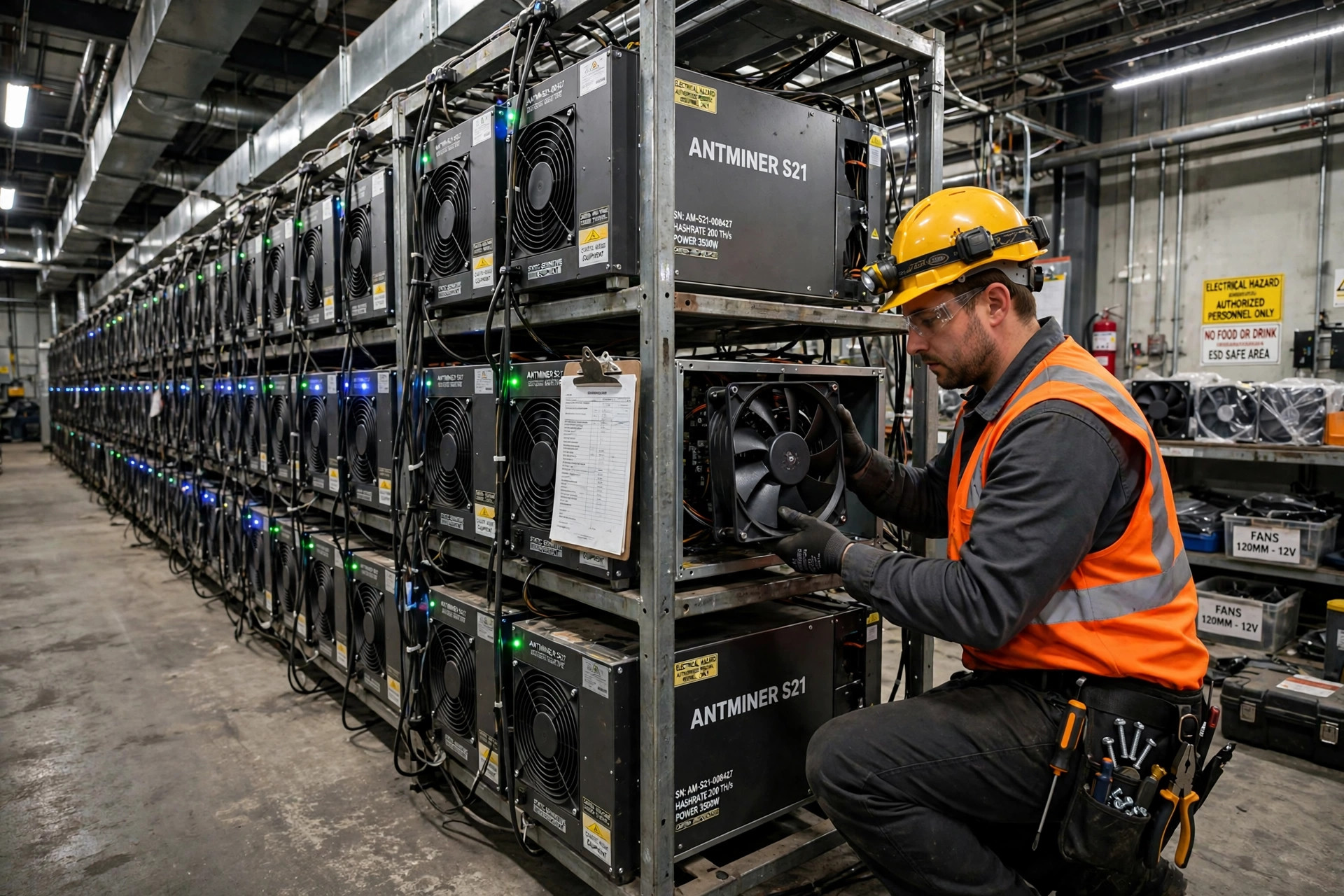
A Bitcoin mining farm maintenance schedule turns nameplate hashrate into actual hashrate. Fans fail first, dust chokes airflow second, and one loose breaker can take a whole row offline — so this guide sets out the daily, weekly, monthly and quarterly routine we recommend to MineForgeX buyers, for air, hydro and immersion farms alike.
The Bitcoin Mining Farm Maintenance Schedule
Maintenance is a routine, not a repair call. The schedule below is the one we recommend to buyers taking delivery of a new fleet: small checks often, bigger checks on a fixed calendar, and a full-farm service every quarter.
| Task | Interval | What to check |
|---|---|---|
| Hashrate and temperature audit | Daily | Each miner's hashrate against nameplate; flag any unit 5% or more below |
| Airflow and intake inspection | Weekly | Filters, intake paths, hot-air recirculation |
| Fan and heatsink service | Monthly | Fan spin and bearing noise, heatsink dust |
| Firmware and pool check | Monthly | Firmware version, pool connection, rejected-share rate |
| Coolant and fluid check (liquid farms) | Monthly | Fluid level, clarity, pump pressure |
| Electrical inspection | Quarterly | Breaker torque, PDU load balance, cable heat |
| Full deep service | Quarterly | Whole-farm clean and spare-parts stock count |
Daily hashrate and temperature checks
Every miner reports its hashrate and chip temperature. Check both daily: a miner hashing 5% or more below nameplate, or running hotter than its neighbours, is telling you something before it fails. Log the numbers — a slow decline over a week is a clogged heatsink or a dying fan, and catching it early is a fan swap, not a hashboard repair.
Weekly air-path service
Walk the hot and cold aisles once a week. Filters clog faster than anyone expects in a dusty site, and a clogged filter starves the whole row of air. Check intake paths are clear, exhaust air is not recirculating into the cold aisle, and no miner is blocked by stored boxes or spare parts.
Monthly firmware and electrical checks
Once a month, confirm every miner is on the same firmware version and connected to the intended pool, and check the rejected-share rate. Apply firmware updates one row at a time, never to the whole farm at once. On the electrical side, a monthly look at PDU loads and cable temperatures catches the slow problems: a breaker running warm, or a row creeping over its planned load as miners were added.
Quarterly deep service
Every quarter, shut down one row at a time and do the full job: compressed-air clean of every heatsink, fan inspection and replacement where needed, torque check on every breaker, fluid service on liquid loops, and a count of the spare-parts shelf.
Air-Cooled Farms: Fans, Filters and Dust
Most Bitcoin farms are still air-cooled, and air cooling has exactly one moving part that matters: the fan.
Fans fail first
A miner's fans run at full speed, around the clock, for years. They are the first component to fail on any air-cooled ASIC, and a failed fan takes its miner offline or into thermal throttling within minutes. Keep spare fans on the shelf for every model you run, and replace a noisy fan the day you hear it. The Bitmain Antminer S21 Pro (234 TH/s, 3,510 W, 15.0 J/TH, $3,490) and the MicroBT Whatsminer M60S+ (210 TH/s, 3,570 W, 17.0 J/TH, $2,880) are both air-cooled workhorses with the same rule: the fan is a consumable, budget for it.
Filters and airflow
Dust is the slow killer: a thin layer on a heatsink raises chip temperature, which means lower hashrate or a throttled miner. Filter the intake air, clean the filters on the weekly walk, and keep the cold aisle genuinely cold — a miner breathing its own exhaust works against itself. Where a farm converts air-cooled miners to immersion, the fans come off and the miner needs a fan simulator to run without a fan-error shutdown; MineForgeX stocks smart fan simulator plugs at $500 for a 120-pack that covers 30 miners.
Hydro and Immersion Cooling Maintenance
Liquid cooling removes the fan problem and replaces it with a plumbing problem. The maintenance changes character: fewer moving parts on the miner, more attention to the loop.
Hydro loops: manifolds, hoses and dry coolers
Hydro miners such as the Bitmain Antminer S23 Hyd (580 TH/s, 5,510 W, 9.5 J/TH, $13,300) and the Antminer S23e Hyd 2U (865 TH/s, 8,650 W, 10.0 J/TH, $9,529) run on direct-to-chip water blocks fed by manifolds. Monthly checks are hose connections, quick-disconnect seals and pump pressure; quarterly checks are coolant condition and dry-cooler fin cleaning. A leaking quick-disconnect is the hydro equivalent of a failed fan — cheap to fix, expensive to ignore. MineForgeX stocks the quick-disconnect hose kit for 4-miner loops at $520, the 120kW dry cooler at $7,450 and the 240kW adiabatic dry cooler at $13,900, both with a 24-month warranty.
Immersion tanks and dielectric fluid
Immersion takes the miner out of the air entirely: the whole unit sits in dielectric fluid in a tank, and the fluid carries the heat to a dry cooler. There are no fans to fail and no dust to clean. The work moves to the fluid: check the level monthly, top up for evaporation and drag-out, and watch clarity — cloudy fluid means contamination and a filter or fluid change. See our immersion cooling guide for the full comparison of air, hydro and immersion. The immersion-ready fleet in the MineForgeX catalog runs from the compact Avalon A1466I to the 522 TH/s Whatsminer M78S:
| Model | Hashrate | Power | Efficiency | Price |
|---|---|---|---|---|
| MicroBT Whatsminer M78S Immersion | 522 TH/s | 7,047 W | 13.5 J/TH | $8,500 |
| MicroBT Whatsminer M76S+ Immersion | 440 TH/s | 5,500 W | 12.5 J/TH | $9,500 |
| MicroBT Whatsminer M66S+ Immersion | 318 TH/s | 5,406 W | 17.0 J/TH | $7,200 |
| Bitmain Antminer S21 XP Immersion | 300 TH/s | 4,050 W | 13.5 J/TH | $5,990 |
| MicroBT Whatsminer M66S Immersion | 298 TH/s | 5,513 W | 18.5 J/TH | $4,900 |
| Canaan Avalon A1566I Immersion | 249 TH/s | 4,500 W | 18.1 J/TH | $3,100 |
| Bitmain Antminer S21 Immersion | 239 TH/s | 3,824 W | 16.0 J/TH | $3,290 |
| Canaan Avalon A1466I Immersion | 170 TH/s | 3,655 W | 21.5 J/TH | $2,190 |
The Whatsminer M66S+ Immersion is the mid-range immersion pick at $7,200: 318 TH/s in a tank, no fans, no dust. Tanks scale with the fleet: the ForgeTank 2-slot quiet tank at $2,190, the 4-slot Pro at $3,490, the 8-slot cluster at $5,900, and the 24-slot enterprise system at $14,800. Synthetic dielectric coolant is $1,290 for a 200L drum and $5,400 for a 1000L tote.
Electrical Maintenance: PDUs, Breakers and 3-Phase Power
Electrical maintenance is the least visible and the most consequential. Hydro and immersion miners run on 380–415V 3-phase power; air-cooled miners on 200–240V. Both need the same discipline:
- Balance the load across phases — an unbalanced feed overheats the heavy phase and wastes capacity.
- Torque-check breakers quarterly: a loose connection heats up, and heat loosens it further — a slow failure that ends in a burnt breaker.
- Keep spare breakers and a spare PDU on the shelf. The MineForgeX enterprise 3-phase metered PDU (415V, 63A) powers up to 12 miners, costs $1,190 and carries a 36-month warranty.
- Model the power bill before ordering: the MineForgeX calculator turns a miner's wattage into a daily cost at your power price, so the maintenance budget and the electricity budget are planned together.
Spares, Warranty and When to Call the Manufacturer
A farm that cannot fix itself in an hour loses hashrate. The spares shelf below is what we recommend holding for a 1 MW deployment:
| Item | Use | Price |
|---|---|---|
| ForgeTank 2-Slot Quiet Immersion Tank | 2-miner immersion setup | $2,190 |
| ForgeTank 4-Slot Pro Immersion Tank | 4-miner immersion setup | $3,490 |
| ForgeTank 8-Slot Cluster Tank | 8-miner immersion setup | $5,900 |
| ForgeTank 24-Slot Enterprise System | 24-miner immersion setup | $14,800 |
| 120kW Industrial Dry Cooler with VFD Fans | Heat rejection for liquid loops | $7,450 |
| 240kW Adiabatic Dry Cooler Unit | Heat rejection for larger liquid loops | $13,900 |
| Synthetic Dielectric Coolant, 200L Drum | Immersion fluid top-up | $1,290 |
| Synthetic Dielectric Coolant, 1000L IBC Tote | Immersion fluid fill | $5,400 |
| Smart Fan Simulator / Spoofers, 120-pack | Fan-error bypass for immersion miners | $500 |
| Enterprise 3-Phase Metered PDU, 415V 63A | Metered power for up to 12 miners | $1,190 |
| Industrial Quick-Disconnect Hose Kit | Plumbing for 4 hydro miners | $520 |
Warranty terms are confirmed in writing on the quote: 12 months on most miners, 6 months on the Whatsminer M56S and M56S++ immersion models, 24 months on ForgeTank 2, 4 and 8 and both dry coolers, 36 months on the ForgeTank 24 system and the enterprise PDU.
This guide is for a buyer running a real farm — a container, a warehouse or a purpose-built site — who wants the hashrate they paid for, every day. It is not for a buyer who wants a miner to run untouched for a year: no cooling type does that.
Frequently Asked Questions
How often should air filters be cleaned on a Bitcoin mining farm?
Check them on the weekly walk and clean them when visibly loaded — weekly in a dusty site, fortnightly to monthly in a clean warehouse. A clogged filter starves the whole row of air.
What fails first on an ASIC miner?
The fans. They run at full speed around the clock, and a noisy fan is the warning before a dead one. Keep spares for every model you run, and replace a rattling fan the day you hear it.
How often does immersion fluid need changing?
Top it up monthly for evaporation and drag-out, and watch clarity: cloudy fluid means contamination and a filter or fluid change. There is no fixed calendar interval — the fluid's condition decides.
Does maintenance work affect the miner warranty?
Check the warranty terms before opening a unit — work done outside the warranty process can affect cover. MineForgeX confirms the exact term in writing on the quote.
One clear next step: pick your cooling type, price the spares shelf from the table above, and request a quote with the model, quantity, power price and destination.
Discuss this with the MineForgeX team
Questions about the hardware, cooling, or deployment in this article? Request a quote for your facility.
Consult Team →