Data Centers
Bitcoin Miner Cooling: Air, Hydro or Immersion Guide
Compare air, hydro and immersion bitcoin miner cooling for enterprise fleets on real specs, costs and site needs — request a quote for your fleet today.
#Cooling #Hydro #Immersion
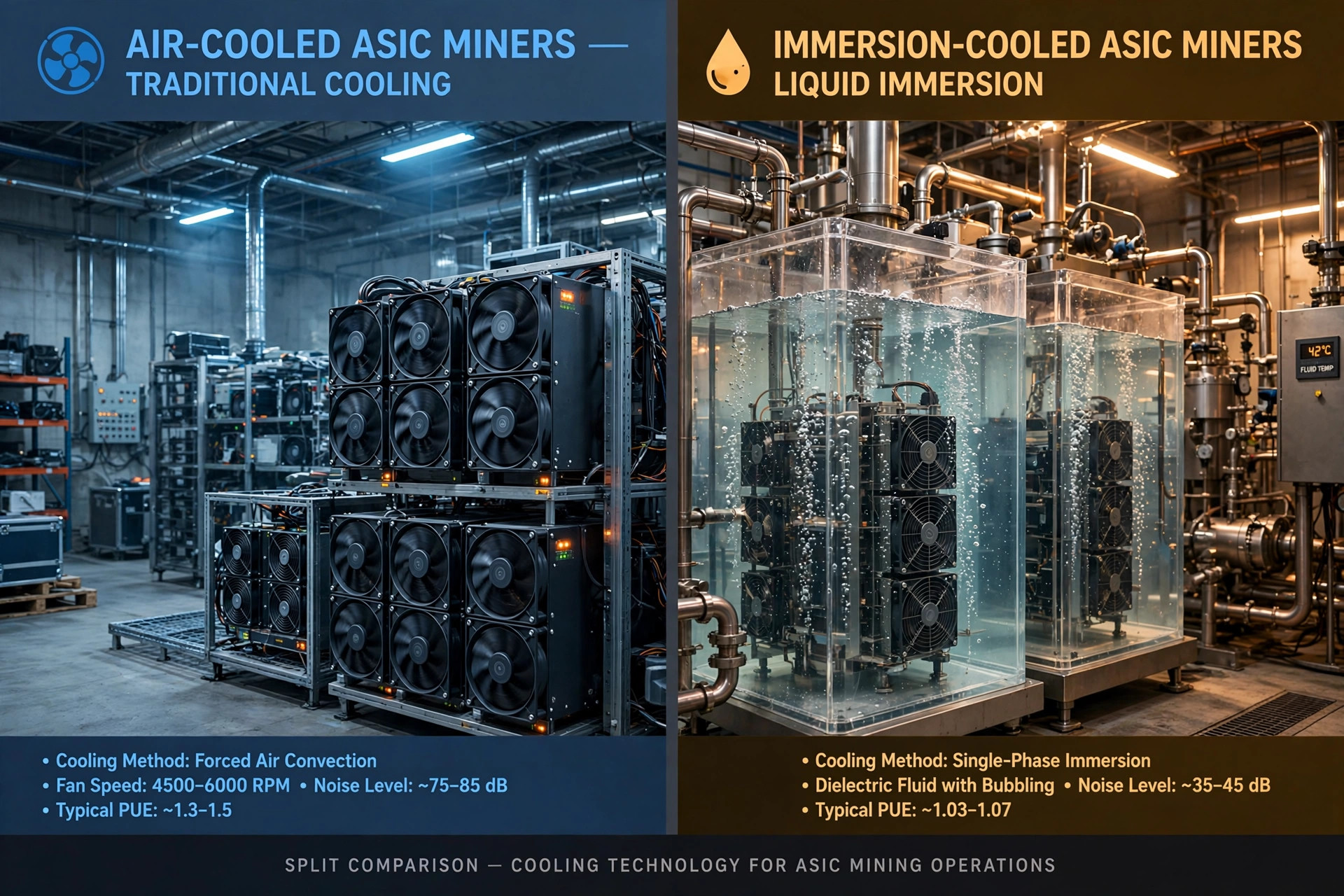
Bitcoin miner cooling is the choice that decides whether a fleet runs cheaply or fights heat all its life, and the right answer depends on the site, not the miner alone. Air cooling is simplest and cheapest to deploy, hydro packs more hashrate into each rack at the best efficiency here, and immersion runs silent and dust-free but needs tanks, fluid and handling. This guide compares all three on verified catalog specs so an operator can match cooling to power, space and budget before ordering.
Why Bitcoin Miner Cooling Decides Fleet Economics
Every watt a miner draws becomes heat that must be removed, so a 1 MW hall needs roughly 1 MW of heat removal plus pump and fan overhead. Cooling sets the ceiling on density, the floor under operating cost, and the maintenance load for the life of the fleet.
Heat is the whole power bill, twice over
Miners convert almost all their electricity into heat, so cooling energy is paid for on top of mining energy. The cheaper path is the one whose extra equipment costs less than the efficiency and density it unlocks, which is why the comparison below prices both the miner and its daily electricity per terahash.
Compare efficiency (J/TH) with cooling type, never alone: the most efficient miners here are liquid-cooled because removing heat at the chip avoids thermal throttling.
Air Cooling: Simple, Proven, and Limited by Airflow
Air-cooled miners need nothing beyond power, ventilation and dust control, which is why they still suit most first halls, smaller sites and any operator that wants miners running days after delivery rather than weeks after a plumbing project.
Where air wins
Air-cooled units run on standard 200 to 240 V single-phase power, arrive ready to rack, and can be moved without draining a loop or handling fluid. Maintenance is familiar work: filter changes, fan swaps and clean intake air. For a site under a few hundred kilowatts, or a first deployment where speed matters more than maximum density, air is usually the right call.
Where air stops working
Air hits its limit in hot climates, dusty halls and at high density. The three air models below draw 3,498 to 3,850 W each and run at 75 to 76 dB, so a large hall needs serious ventilation and hearing protection on walk-rounds. Density per rack stays lower than liquid options because each chassis needs airflow around it, and summer derating is a real planning factor in warm regions.
| Model | Hashrate | Power | Efficiency | Price | Cost per TH/s |
|---|---|---|---|---|---|
| Bitmain Antminer S23 | 318 TH/s | 3,498 W | 11.0 J/TH | $7,750 | $24.37 |
| Bitdeer SealMiner A4 Pro Air | 336 TH/s | 3,662 W | 10.9 J/TH | $6,750 | $20.09 |
| Canaan Avalon A16XP | 300 TH/s | 3,850 W | 12.8 J/TH | $5,000 | $16.67 |
Hydro Cooling: Direct-to-Chip Density for Serious Halls
Hydro miners route coolant through cold plates fixed directly to the hashboards, carrying heat out of the rack through manifolds to dry coolers or cooling towers. It is the densest practical cooling for most enterprise halls and the route behind the two most efficient miners in this guide.
Where hydro wins
Hydro removes heat at the chip, so racks pack tighter and run quieter: the models below run at 50 to 75 dB against 75 to 76 dB for air, and the S23 XP Hyd reaches 8.9 J/TH, the best efficiency in this guide. Heat leaves as warm water, suiting sites that reuse heat. For a hall above roughly 1 MW with three-phase power available, hydro usually pays back its loop cost through efficiency and density.
What a hydro site must have ready
Hydro needs three-phase power at 380 to 415 V (380 to 480 V for the M7DS), a loop with pumps sized for every unit, manifolds, filtration and heat rejection sized for the hottest week of the year, not the annual average. Budget for seals, quick-disconnect spares, leak detection per rack and coolant chemistry checks. A hydro miner without circulating coolant cannot shed heat safely, so never order hydro units for a site where the loop is still unbudgeted. The container and hall options that pair with these models are described on /infrastructure. Full details for the efficiency leader are at /product/antminer-s23-xp-hyd-600t.
| Model | Hashrate | Power | Efficiency | Price | Cost per TH/s |
|---|---|---|---|---|---|
| Bitmain Antminer S23 XP Hyd | 600 TH/s | 5,340 W | 8.9 J/TH | $15,300 | $25.50 |
| Bitdeer SealMiner A4 Ultra Hydro | 886 TH/s | 8,373 W | 9.45 J/TH | $10,600 | $11.96 |
| MicroBT Whatsminer M7DS | 680 TH/s | 9,200 W | 13.53 J/TH | $7,599 | $11.18 |
Immersion Cooling: Silent, Dust-Free, and Operationally Demanding
Immersion miners are submerged in dielectric fluid in tanks, which removes fans, dust and vibration entirely. Every immersion model below runs at 0 dB, and that silence plus the absence of airborne dust is the core attraction for operators that value hardware longevity and quiet halls.
Where immersion wins
With no fans to fail and no dust reaching the boards, immersion suits dusty environments, noise-restricted sites and operators planning long hardware lives. The S23 Imm at 12.0 J/TH and the S21 XP Immersion at 13.5 J/TH show immersion can be efficient too, and tank farms scale by adding tanks rather than rebuilding a hall.
What immersion demands in return
Immersion adds tanks, fluid, filtration, drying and handling, plus three-phase power at 380 to 415 V. Fluid is a consumable with a disposal route, board swaps mean lifting hardware out of a tank and drying it, and staff need training before the first tank is filled. Those costs are manageable for a committed operator and prohibitive for a casual one, which is exactly why immersion is a site decision first and a miner decision second.
| Model | Hashrate | Power | Efficiency | Price | Cost per TH/s |
|---|---|---|---|---|---|
| Bitmain Antminer S23 Imm | 442 TH/s | 5,304 W | 12.0 J/TH | $9,650 | $21.83 |
| MicroBT Whatsminer M76S+ Immersion | 440 TH/s | 5,500 W | 12.5 J/TH | $9,500 | $21.59 |
| Bitmain Antminer S21 XP Immersion | 300 TH/s | 4,050 W | 13.5 J/TH | $5,990 | $19.97 |
| Canaan Avalon A1566I Immersion | 249 TH/s | 4,500 W | 18.1 J/TH | $3,100 | $12.45 |
| MicroBT Whatsminer M66S Immersion | 298 TH/s | 5,513 W | 18.5 J/TH | $4,900 | $16.44 |
Side-by-Side: Daily Electricity Cost per Terahash
Daily electricity per terahash is efficiency multiplied by 0.024 kWh and by the power price. At $0.08 per kWh that is J/TH times $0.00192, and it separates the cooling options more starkly than efficiency alone suggests.
| Model | Cooling | J/TH | Daily cost per TH/s at $0.08/kWh |
|---|---|---|---|
| Antminer S23 XP Hyd | Hydro | 8.9 | $0.017 |
| SealMiner A4 Ultra Hydro | Hydro | 9.45 | $0.018 |
| SealMiner A4 Pro Air | Air | 10.9 | $0.021 |
| Antminer S23 | Air | 11.0 | $0.021 |
| Antminer S23 Imm | Immersion | 12.0 | $0.023 |
| Whatsminer M76S+ Immersion | Immersion | 12.5 | $0.024 |
| Avalon A16XP | Air | 12.8 | $0.025 |
| Antminer S21 XP Immersion | Immersion | 13.5 | $0.026 |
| Whatsminer M7DS | Hydro | 13.53 | $0.026 |
| Avalon A1566I Immersion | Immersion | 18.1 | $0.035 |
| Whatsminer M66S Immersion | Immersion | 18.5 | $0.036 |
Across a 10 PH/s fleet, the gap between $0.017 and $0.036 per TH/s per day is $190 per day, or roughly $69,000 per year at a flat power price, before purchase price or cooling equipment. That is why cooling choice deserves the same scrutiny as miner choice, and why the answer changes with power price: at $0.04 per kWh the gap halves, at $0.12 it grows by half again. Run each candidate at your own power price using the calculator tool at /calculator, and treat every figure here as arithmetic from catalog specs, not as a promise of income.
Choosing for Your Site
Start from the site, then pick the miner. Air fits a fast, simple deployment on single-phase power. Hydro fits a three-phase hall above roughly 1 MW that wants density and the best efficiency. Immersion fits an operator committed to tanks and fluid handling that wants silence and dust-free boards. Mixed fleets are legitimate too: air for a first row while a hydro loop is built, or immersion tanks for a dusty wing of an air-cooled hall.
Who this guide is for, and who it is not for
This guide is for data centre operators, institutional buyers and fleet owners choosing cooling for SHA-256 capacity, where efficiency figures are comparable. It is not for buyers choosing between algorithms, where J/TH cannot be compared across coins, and it is not a revenue forecast: no figure here promises income, and profitability depends on difficulty, coin price and power price, all of which move.
Can an air-cooled miner be converted to hydro or immersion later?
No, not practically. Cooling is built into the chassis or cold plates at manufacture, so choose it at purchase and treat a later change as a fleet replacement, not an upgrade.
Is the most efficient miner always the best buy?
No. The S23 XP Hyd leads on efficiency at 8.9 J/TH but costs $25.50 per TH/s and is pre-order, while the M7DS costs $11.18 per TH/s at 13.53 J/TH. Compare purchase price plus electricity over the planned service life, plus allocation timing and warranty.
Does immersion cooling eliminate maintenance?
It eliminates fans and dust but adds fluid management: filtration, chemistry checks and drying after board work. Maintenance changes form rather than disappearing, and staff training belongs in the project budget.
What should I confirm before ordering?
Hashrate and allocation for the model you want, your site's power type and capacity, the cooling and heat-rejection design, warranty length for that exact model, and freight terms to your destination. One clear next step: shortlist from the tables above, run each candidate at your power price, and request a quote stating hashrate, power price, cooling status and destination so the quotation matches the site you actually run.
Discuss this with the MineForgeX team
Questions about the hardware, cooling, or deployment in this article? Request a quote for your facility.
Consult Team →