Hardware
Whatsminer Fleet Guide 2026: M60S+ to M79S
MicroBT Whatsminer fleet guide 2026: M60S+, M70S+, M73S+ Hydro, M7AS+ and M79S compared on hashrate, J/TH and price. Read the guide and request a quote.
#Hardware #Whatsminer #Hydro
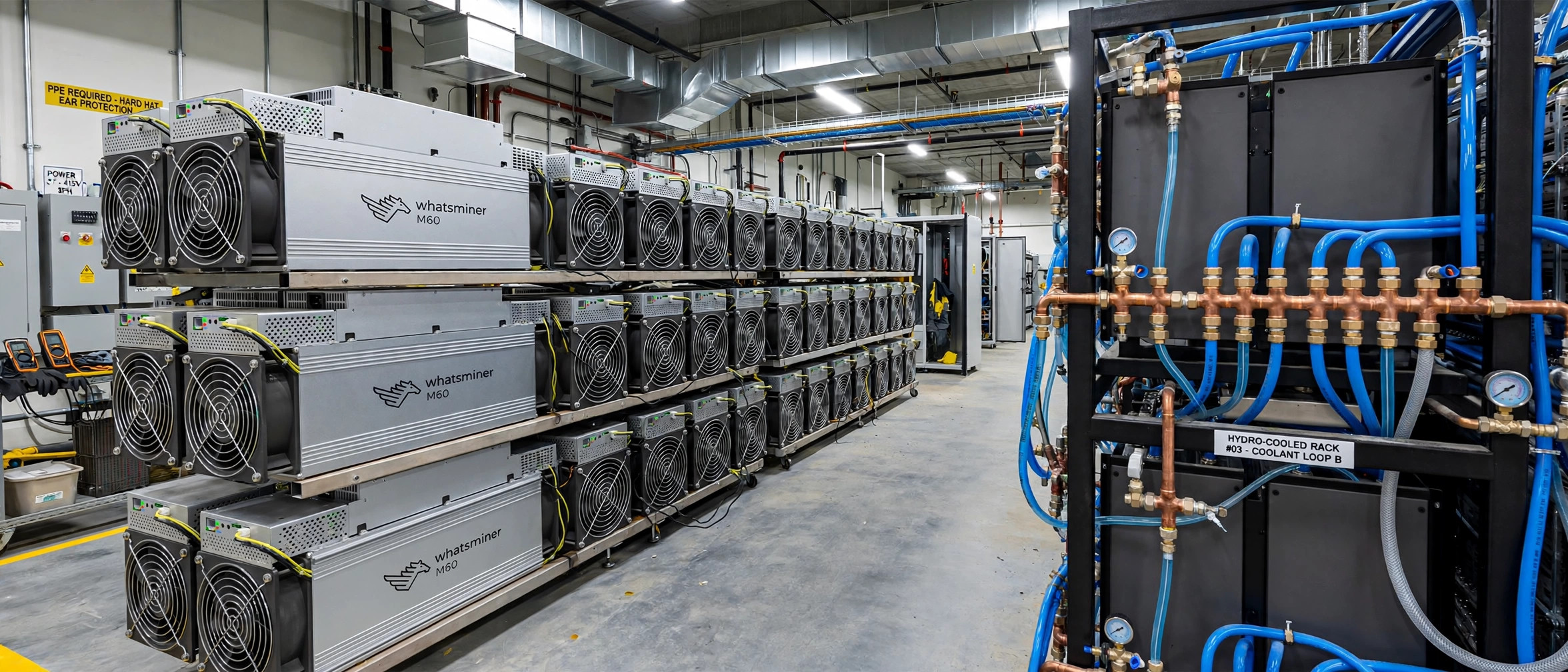
A Whatsminer fleet in 2026 spans 120 TH/s to 1,350 TH/s, 12.5 to 28.0 J/TH, and $1,090 to $12,100 per unit. The short answer: buy the M70S+ (280 TH/s, 12.5 J/TH, $3,850) for single-phase air-cooled space; buy the M7AS+ or the M79S with three-phase power and a coolant loop; and buy the M60S+ (210 TH/s, $2,880) only where power is cheap, because at 17.0 J/TH it barely clears its power bill at $0.08 per kWh.
The Whatsminer Range at a Glance
MicroBT builds the second-largest Bitcoin mining fleet after Bitmain. Every model below is SHA-256, mines Bitcoin, and is listed in the MineForgeX catalog at the price shown.
| Model | Hashrate | Power | Efficiency | Cooling | Price | $ per TH |
|---|---|---|---|---|---|---|
| Whatsminer M50 | 120 TH/s | 3,360 W | 28.0 J/TH | Air | $1,090 | $9.08 |
| Whatsminer M60 | 170 TH/s | 3,383 W | 19.9 J/TH | Air | $2,290 | $13.47 |
| Whatsminer M60S | 190 TH/s | 3,515 W | 18.5 J/TH | Air | $2,890 | $15.21 |
| Whatsminer M60S+ | 210 TH/s | 3,570 W | 17.0 J/TH | Air | $2,880 | $13.71 |
| Whatsminer M60S++ | 226 TH/s | 3,503 W | 15.5 J/TH | Air | $2,213 | $9.79 |
| Whatsminer M70S | 258 TH/s | 3,483 W | 13.5 J/TH | Air | $3,200 | $12.40 |
| Whatsminer M70S+ | 280 TH/s | 3,500 W | 12.5 J/TH | Air | $3,850 | $13.75 |
| Whatsminer M66S Immersion | 298 TH/s | 5,513 W | 18.5 J/TH | Immersion | $4,900 | $16.44 |
| Whatsminer M63S Hydro | 390 TH/s | 7,215 W | 18.5 J/TH | Hydro | $5,900 | $15.13 |
| Whatsminer M7AS+ | 540 TH/s | 6,750 W | 12.5 J/TH | Hydro | $7,000 | $12.96 |
| Whatsminer M73S+ Hydro | 600 TH/s | 7,500 W | 12.5 J/TH | Hydro | $9,000 | $15.00 |
| Whatsminer M79S | 1,350 TH/s | 20,000 W | 14.8 J/TH | Hydro | $12,100 | $8.96 |
Air-Cooled Whatsminers: M60, M60S+ and M70S+
Air cooling is the default: no coolant loop, no tanks, no dry cooler. Every air-cooled Whatsminer runs on 200–240V single-phase power, with a 12-month warranty except the M50 and M50S++ at 6 months. The trade-off is noise — 75 dB — and heat of about 3.5 kW per unit, so ventilation decides how many a room can hold.
The M60 family: the entry ladder
The M60 family is five rungs of the same idea, from the M50 at 120 TH/s for $1,090 to the M60S++ at 226 TH/s for $2,213. Efficiency improves as you climb — 28.0, 19.9, 18.5, 17.0 and 15.5 J/TH — and the M60S++ is both cheaper than the M60S+ and more efficient, at $9.79 per TH against $13.71. On a budget, the M60S++ is the value pick; the M50 only makes sense where power is nearly free.
M70S and M70S+: the air-cooled flagships
The M70S (258 TH/s, 13.5 J/TH, $3,200) and M70S+ (280 TH/s, 12.5 J/TH, $3,850) are the most efficient air-cooled Whatsminers ever sold, and the only air models that stay profitable at $0.08 per kWh on the November 2026 snapshot. Both are Limited Allocation, so request a quote before planning a deployment around them.
The M50S+ flash-sale deal — read the conditions
MicroBT's own storefront listed the Whatsminer M50S+ (152 TH/s, 3,344 W, 22 J/TH) at a $623.20 flash-sale price in November 2026 — with a five-unit minimum, and delivery and import costs excluded. At 22 J/TH it is a generation behind the fleet, earning its keep only at very cheap power or as bulk filler capacity. The comparable single-unit M50S++ (150 TH/s) lists at $1,690.
Hydro-Cooled Whatsminers: M73S+, M7AS+ and M79S
Hydro cooling moves heat with water: cold plates, a coolant loop, and a dry cooler outside. The payoff is density and silence — 35–50 dB instead of 75 dB — and the price is infrastructure. Every hydro Whatsminer needs 380–415V or 380–480V three-phase power and a working coolant loop; without the loop, the miner cannot run. Budget the loop with the miner, using the turnkey container costs guide if the deployment is a container.
M73S+ Hydro and M7AS+: 12.5 J/TH at two scales
The M7AS+ (540 TH/s, 6,750 W, 12.5 J/TH, $7,000, in stock) and the M73S+ Hydro (600 TH/s, 7,500 W, 12.5 J/TH, $9,000, Limited Allocation) are the efficiency core of the range. The M7AS+ is the better buy per terahash at $12.96 against $15.00, and it is in stock while the M73S+ is Limited Allocation. Both need three-phase power — 380–480V for the M7AS+, 380–415V for the M73S+ — and both run at 35–50 dB.
M79S: 1,350 TH/s in one rack unit
The Whatsminer M79S is the highest single-unit hashrate in the MineForgeX catalog: 1,350 TH/s from one hydro rack unit at 20,000 W and 14.8 J/TH, priced at $12,100. At $8.96 per terahash it is the cheapest hashrate in the range, replacing roughly five M70S+ units with one. The catch is concentration: 20 kW in one unit needs a 380–415V three-phase feed and a coolant loop sized for the full 20 kW, and a single failure takes 1,350 TH/s offline at once. It is a density machine for operators who already run hydro at scale. It nets about $6.27 a day at $0.08 per kWh on the November snapshot — density is the reason to buy it, not payback speed.
Immersion Whatsminers: M66, M66S, M76S+ and M78S
Immersion cooling submerges the miner in dielectric fluid: no fans, no dust, no noise — 0 dB — and the highest rack density of any cooling method. The range runs from the M66 (280 TH/s, 19.9 J/TH, $4,400) and M66S (298 TH/s, 18.5 J/TH, $4,900) up to the M76S+ Immersion (440 TH/s, 12.5 J/TH, $9,500) and M78S Immersion (522 TH/s, 13.5 J/TH, $8,500).
M66 and M66S: fanless immersion
The M66 and M66S are the quietest miners MicroBT sells — fanless, 0 dB, sealed against dust. Their efficiency is mid-range at 19.9 and 18.5 J/TH: at $0.08 per kWh the M66S loses about $0.73 a day on the November snapshot, turning positive only below about $0.075 per kWh.
M76S+ and M78S: immersion density
The M76S+ Immersion (440 TH/s, 12.5 J/TH, $9,500) and M78S Immersion (522 TH/s, 13.5 J/TH, $8,500) bring flagship efficiency to immersion. Both are Limited Allocation and carry a 12-month warranty. The M78S is the better value at $16.28 per TH against $21.59 for the M76S+, though the M76S+ wins on running cost.
What a Whatsminer Costs to Run
The table below runs six Whatsminers through the same maths: daily gross revenue at the November 2026 hashprice snapshot of about $33.09 per PH per day, daily power cost at $0.08 per kWh, and the resulting net, break-even power price and payback. Treat every figure as a sizing exercise on that snapshot, not a forecast. Pool fees (typically 1–3%), cooling-plant energy and downtime are excluded; the power cost is the miner's own watts only.
| Model | Daily gross | Daily power | Daily net | Break-even power | Payback |
|---|---|---|---|---|---|
| Whatsminer M79S | $44.67 | $38.40 | $6.27 | $0.093/kWh | ~1,930 days |
| Whatsminer M73S+ Hydro | $19.85 | $14.40 | $5.45 | $0.110/kWh | ~1,651 days |
| Whatsminer M7AS+ | $17.87 | $12.96 | $4.91 | $0.110/kWh | ~1,426 days |
| Whatsminer M70S+ | $9.27 | $6.72 | $2.55 | $0.110/kWh | ~1,510 days |
| Whatsminer M60S+ | $6.95 | $6.85 | $0.10 | $0.081/kWh | None at $0.08 |
| Whatsminer M66S Immersion | $9.86 | $10.59 | −$0.73 | $0.075/kWh | None at $0.08 |
Three lessons sit in that table. Break-even power price is set by efficiency alone: every 12.5 J/TH machine breaks even near $0.110 per kWh, while the M60S+ breaks even at $0.081 and the M66S at $0.075. The highest daily net belongs to the biggest machine: the M79S nets $6.27 a day. And payback is long everywhere: 1,426 to 1,930 days even for the best machines. At $0.05 per kWh the M66S nets about $3.24 a day — the power contract matters more than the model choice.
Who Should Buy a Whatsminer — and Who Should Not
A Whatsminer suits an operator who has chosen MicroBT's ecosystem, or who buys on dollars per terahash and single-phase simplicity. The M70S+ fits air-cooled sites; the M7AS+ and M73S+ Hydro fit farms with three-phase power and a coolant loop; the M79S fits hydro operators buying density. A buyer ordering five or more units should price the order as a fleet — the bulk wholesale procurement guide covers batch pricing and landed DDP cost.
A Whatsminer is the wrong buy in three cases. First, a home miner: 75 dB air models and 3.5 kW of heat per unit do not belong in a living space, and hydro and immersion models need industrial power and cooling plant. Second, a buyer paying $0.10 or more per kWh: only the 12.5 J/TH machines clear their power bill. Third, a buyer without cooling infrastructure ordering a hydro or immersion model.
Frequently Asked Questions
Which Whatsminer is the most efficient in 2026?
Four models share the best efficiency in the MicroBT range at 12.5 J/TH: the M70S+ (air), the M73S+ Hydro, the M7AS+ (hydro) and the M76S+ Immersion. The choice between them is a cooling and power decision.
Is the Whatsminer M79S worth $12,100?
For a hydro operator buying density, yes: 1,350 TH/s at $8.96 per TH is the cheapest hashrate in the range, netting about $6.27 a day at $0.08 per kWh on the November 2026 snapshot. As a payback purchase it is slow — about 1,930 days — so buy it for rack density, not for a fast return.
Can I run a Whatsminer at home?
Not practically. The air-cooled models run on 200–240V single-phase power, but they produce 75 dB of fan noise and about 3.5 kW of heat each, and the hydro and immersion models need three-phase power plus a coolant loop or tank. Home miners should look at quiet sub-40 dB home miners instead.
What warranty do Whatsminers carry?
Twelve months on the M60, M60S, M60S+, M70S, M70S+, M73S+ Hydro, M79S, M7AS+ and M66S; six months on the M50, M50S++, M53 and M56S — confirmed in writing on the quote.
One clear next step: decide your cooling and power position — single-phase air, three-phase hydro, or immersion — then request a quote with the model, quantity, power price, cooling status and destination.
Discuss this with the MineForgeX team
Questions about the hardware, cooling, or deployment in this article? Request a quote for your facility.
Consult Team →