Data Centers
Turnkey Mining Containers: 2026 Deployment Guide
A turnkey mining container deploys megawatts in weeks, not months. Compare MineForgeX hydro, immersion and air containers, then request a quote today.
#Containers #Turnkey #Megawatt
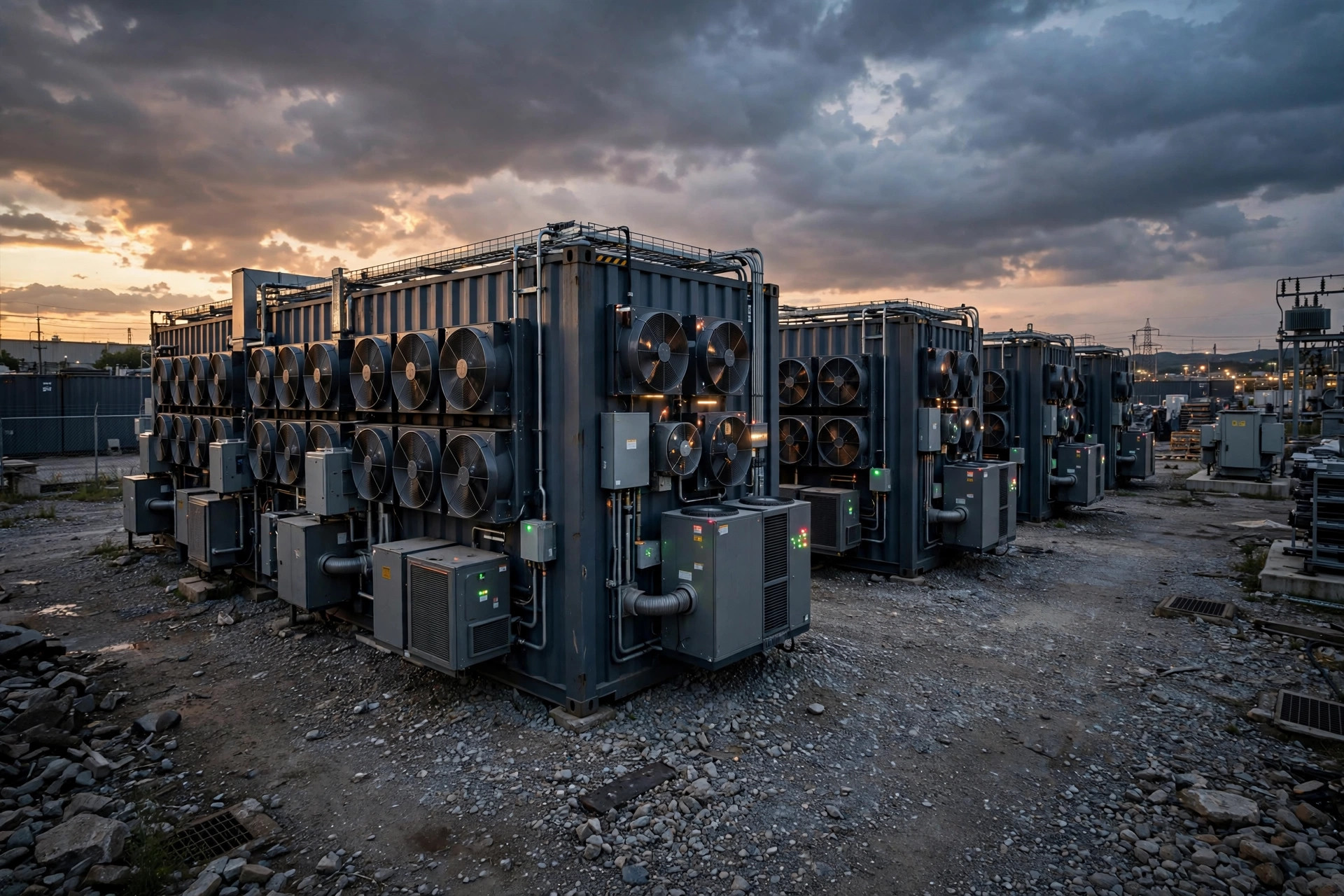
A turnkey mining container is a factory-built ISO shipping container converted into a complete mining facility: power distribution, cooling, networking, monitoring and racking installed and tested before it leaves the factory. Instead of a conventional building project, the operator prepares a gravel pad and a power interconnect, the container arrives by truck, and the fleet energizes in days to weeks once power and cooling are connected. For data centre operators and institutional buyers, that speed is the point: a turnkey mining container turns a site acquisition into an operating fleet while a traditional build would still be in permitting.
What a Turnkey Mining Container Includes
The container itself is the least complicated part of the purchase. The value is everything installed inside it before shipping: the electrical distribution board, the cooling distribution, the racking or tank mounts, the monitoring and safety circuits, and the fire suppression. MineForgeX's 40ft Turnkey Hydro Mining Container, for example, arrives with primary and secondary water loops, Schneider switchgear, smart metering and automated fire suppression already fitted and factory-tested. The buyer still provides the site, the power, and the miners — but not the months of contractor coordination between those pieces.
The shell is the easy part
All three MineForgeX containers use ISO high-cube steel shells: 12,192 x 2,438 x 2,896 mm for the 40ft units and 6,058 x 2,438 x 2,896 mm for the 20ft immersion unit. They are weatherproof, transportable by standard truck and crane, and relocatable if a site's power economics change. That mobility is a real operational advantage over a fixed building: a container fleet can move to cheaper power, while a poured concrete hall cannot.
What arrives tested, and what it does not include
Factory testing covers the container's own systems — switchgear, distribution, pumps or fans, monitoring and safety circuits. It does not cover the buyer's side of the project: the gravel pad, the transformer and utility interconnect, external heat rejection for liquid loops, the network uplink, the miners themselves, and dielectric fluid for immersion units. Price a container project on the whole list, not the container line alone, or the budget will be wrong before the first miner is racked.
Hydro, Immersion or Air: Choosing a Turnkey Mining Container
The cooling method decides which miners the container can hold, because the cooling method is part of the miner's design. Hydro miners run on direct-to-chip cold plates fed by a treated water loop. Immersion miners are fanless units built to sit in dielectric fluid. Air miners are conventional fan-cooled units. A container built for one method does not accept the others without the manufacturer's explicit guidance for that model.
- Hydro containers: the densest and most efficient option at scale. The 40ft hydro container holds up to 288 hydro servers and up to 140 PH/s of capacity. The trade-off is a water loop that must be engineered, treated and maintained, plus external heat rejection.
- Immersion containers: the quietest option, with zero dust ingress and no fan failure mode. MineForgeX's 20ft immersion container houses eight 100 kW tanks and up to 192 submerged miners, with a bunded containment floor and leak detection. The trade-off is fluid as an ongoing consumable and a servicing discipline built around draining and lifting miners.
- Air containers: the simplest and cheapest container, at $46,000 for 1.5 MW and up to 384 air-cooled miners. The trade-off is noise — 80 dB at the unit — plus airflow and filtration limits that cap density in hot or dusty sites.
Noise figures matter for permitting: the hydro container is rated at 55 dB and the immersion container at 50 dB, against 80 dB for the air-cooled unit. Where a site sits near neighbours or a noise ordinance, that gap alone can decide the cooling method.
Container Comparison: Capacity, Miners and Price
| MineForgeX container | Power | Miner capacity | Cooling | Price | Warranty |
|---|---|---|---|---|---|
| 40ft Turnkey Hydro Mining Container | 1.6 MW | Up to 288 hydro servers, up to 140 PH/s | Hydro | $89,000 | 36 months |
| 20ft Immersion Container System | 800 kW | Up to 192 submerged miners, up to 70 PH/s | Immersion | $62,000 | 36 months |
| 40ft Air-Cooled Mining Container | 1.5 MW | Up to 384 air-cooled miners, up to 80 PH/s | Air | $46,000 | 24 months |
All three containers are listed as Bulk Order Only, so confirm lead time and allocation before committing a facility timeline. The hydro flagship is detailed at mineforgex.com/product/mineforgex-40ft-hydro-container-1-6mw — its 288-server racking, dual water loops and 36-month warranty make it the reference build for megawatt-scale hydro deployment.
Sizing the Fleet Inside the Container
Container capacity is limited twice: by total power and by rack slots. Divide container watts by miner watts, then cap the result at the container's slot count. The table below does that arithmetic for the 1.6 MW hydro container using current catalog specifications and prices.
| Miner | Hashrate | Power | Efficiency | Power-limited units | Price | Status |
|---|---|---|---|---|---|---|
| Bitmain Antminer S23 Hyd | 580 TH/s | 5,510 W | 9.5 J/TH | 290, slot-capped to 288 | $13,300 | Limited Allocation |
| Bitmain Antminer S21 XP Hydro | 473 TH/s | 5,676 W | 12.0 J/TH | 281 | $8,450 | In Stock (Spot Delivery) |
| Bitmain Antminer S23 XP Hyd | 600 TH/s | 5,340 W | 8.9 J/TH | 299, slot-capped to 288 | $15,300 | Pre-order |
| MicroBT Whatsminer M63S+ Hydro | 450 TH/s | 7,650 W | 17.0 J/TH | 209 | $5,900 | In Stock (Spot Delivery) |
The arithmetic cross-checks against the catalog: 288 S23 Hyd units draw 288 x 5,510 W = 1,587 kW, just inside the 1.6 MW envelope. Efficiency still decides operating cost after purchase: the S23 XP Hyd at 8.9 J/TH draws 5,340 W for 600 TH/s, while the M63S+ Hydro at 17.0 J/TH draws 7,650 W for 450 TH/s. Multiply that gap by your power price and your unit count before choosing on purchase price alone. And note the status column: "Limited Allocation" and "Pre-order" mean allocation must be confirmed before a deployment date is promised to anyone.
Site Preparation: Power, Pad and Heat Rejection
Power interconnect
Containers run on 415V/480V 3-phase power at 50/60 Hz. Size the transformer and interconnect for the container plus the cooling plant load, not the container alone, and check per-row and per-rack capacity for total miner watts plus cooling. In practice the utility interconnect is often the longest-lead item in the whole project — sequence it first, before ordering miners, or the container will arrive before the power does.
Pad and placement
A level gravel pad with drainage, truck access for a 40ft delivery, and crane clearance for placement is the baseline. Leave service clearance around the container: hydro manifolds, immersion tank lids and air-container filter walls all need access without shutting down adjacent capacity. Confirm setback and noise rules for the site before delivery, particularly for the 80 dB air-cooled unit.
Heat rejection loop
Liquid cooling moves heat; it does not make it disappear. Size the external heat-rejection loop — dry cooler or cooling tower — to total fleet watts at summer peak ambient, not at nameplate conditions on a cool day. MineForgeX lists industrial dry coolers from $7,450 for a 120 kW unit to $13,900 for a 240 kW adiabatic unit as heat-rejection hardware for liquid-cooled loops. Air containers reject heat directly through exhaust louvers, but they need airflow clearance and dust management: the air container's washable MERV-8 filtration screens are a maintenance item, not a fit-and-forget feature.
Budgeting, Fit and the Full Project Cost
What the container price excludes
Miners, immersion fluid, external heat rejection, electrical works beyond the container, site preparation and freight are all outside the container price. As an illustration, not a quote: twenty Antminer S21 XP Hydro units at $8,450 each total $169,000, plus the $89,000 hydro container, equals $258,000 before heat rejection, electrical works, pad works and freight. That is the shape of a container budget — the miners are the largest line, but the infrastructure lines are large enough to change the project total if they are omitted.
Modelling returns honestly
Before ordering, model the full facility number — miner watts plus cooling plant load, pool fees and facility overhead — in the profitability calculator at mineforgex.com/calculator, using your actual power price. Hashprice moves with Bitcoin price and network difficulty, so any payback figure is a snapshot at one hashprice, not a promise. No miner or container guarantees income, and any seller who promises a fixed return should be treated with scepticism.
When a container is the wrong choice
Containers are not the answer for every site. If an existing building already has spare electrical capacity, airflow and racking, retrofitting racks inside it is usually cheaper than buying a container. For very small deployments, a container's fixed costs — pad, interconnect and heat rejection — spread across too few miners to make sense. Where water use or heat-rejection permitting is constrained, a liquid-cooled container may face approvals a simple air-cooled hall would not. And if the site's power timeline is longer than the container's lead time, the container waits: sequence power first, then hardware.
For sites where the answer is a container, the decision narrows to cooling method, capacity and miner generation — and to confirming allocation before announcing a date. See the full infrastructure range at mineforgex.com/infrastructure, then request a MineForgeX quote for your container build today: confirm miner allocation, container lead time, DDP delivery to your destination and warranty handling for your order size before you commit a facility timeline.
Discuss this with the MineForgeX team
Questions about the hardware, cooling, or deployment in this article? Request a quote for your facility.
Consult Team →