Hardware
Kaspa Miners Fleet Guide 2026
Kaspa miners guide 2026: 10 kHeavyHash ASICs compared — KS7 40 TH/s at 77 W/TH, prices from $149 to $2,490. See power costs and request a quote today.
#Hardware #Kaspa #kHeavyHash
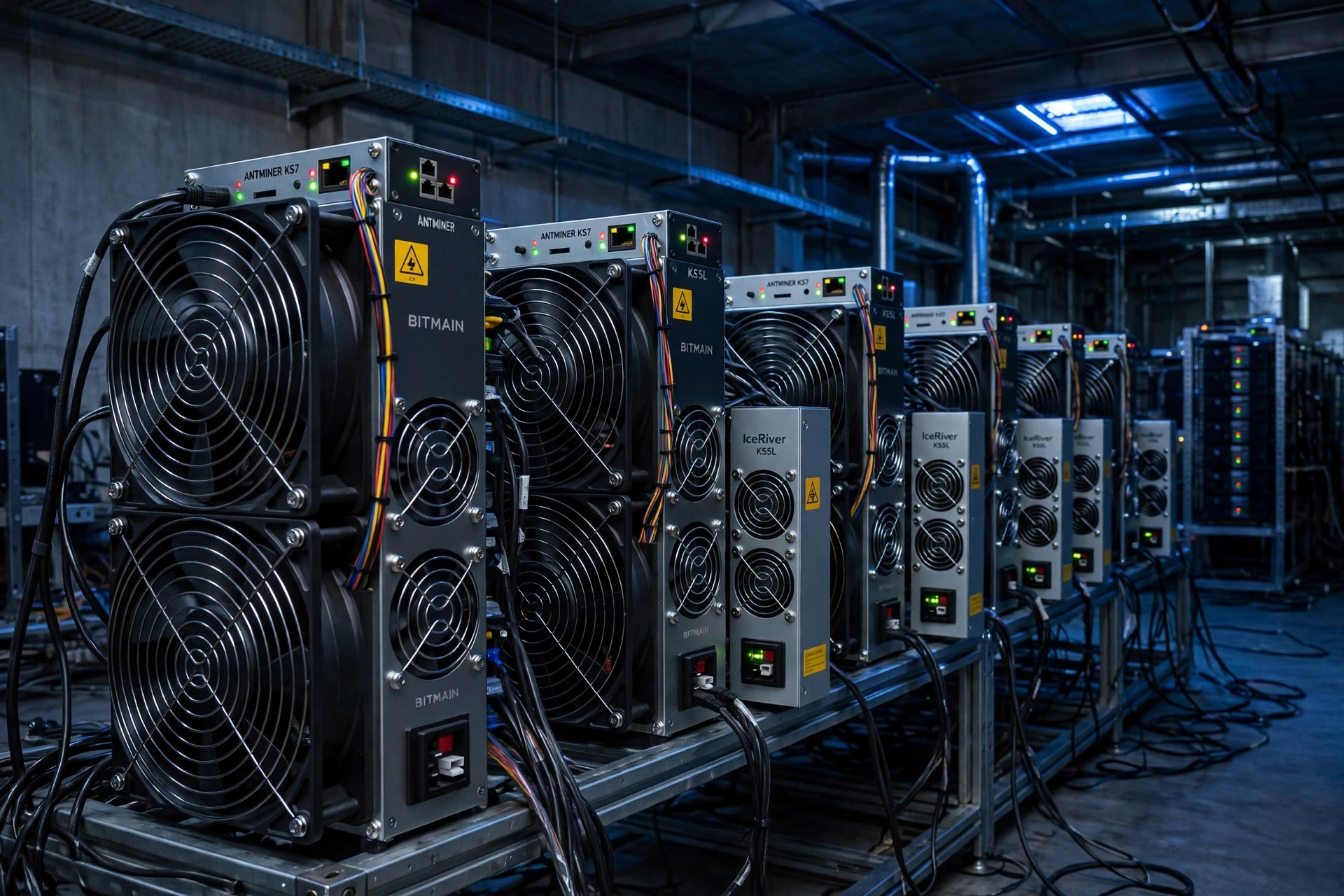
Kaspa miners are kHeavyHash ASICs built for the Kaspa network, and the MineForgeX catalog carries ten, from the $149 IceRiver KS0 Pro to the $2,490 IceRiver KS5M. The flagship is the Bitmain Antminer KS7: 40 TH/s at 77 watts per terahash for $2,050 — the most efficient Kaspa miner and the cheapest hashrate per dollar at $51.25 per terahash. The cheapest way in is the KS0 Pro at $149, and the home-sized option is the Goldshell KA-BOX Pro at $389. Every model is air-cooled; nine of the ten are in stock, and only the Goldshell E-KA1M is Limited Allocation.
The Kaspa Miners Range at a Glance
Kaspa runs on kHeavyHash, a proof-of-work algorithm no Bitcoin miner can run: SHA-256 hardware is useless on this network, and kHeavyHash hardware is useless on Bitcoin. That is why the range is a separate buying decision from the Bitcoin fleet, with its own efficiency scale — watts per terahash (W/TH), never joules per terahash, because the hash being measured is a different one. The table below lists all ten models with catalog-verified figures.
| Model | Hashrate | Power | Efficiency | Price | Cost per TH | Warranty |
|---|---|---|---|---|---|---|
| Antminer KS7 | 40 TH/s | 3,080 W | 77 W/TH | $2,050 | $51.25/TH | 12 mo |
| Antminer KS5 Pro | 21 TH/s | 3,150 W | 150 W/TH | $1,890 | $90.00/TH | 12 mo |
| Antminer KS5 | 20 TH/s | 3,000 W | 150 W/TH | $1,690 | $84.50/TH | 12 mo |
| IceRiver KS5M | 15 TH/s | 3,400 W | 226 W/TH | $2,490 | $166.00/TH | 6 mo |
| IceRiver KS5L | 12 TH/s | 3,400 W | 283 W/TH | $1,990 | $165.83/TH | 6 mo |
| IceRiver KS3M | 6 TH/s | 3,400 W | 566 W/TH | $890 | $148.33/TH | 6 mo |
| Goldshell E-KA1M | 5.5 TH/s | 1,800 W | 327 W/TH | $1,500 | $272.73/TH | 12 mo |
| Goldshell KA-BOX Pro | 1.6 TH/s | 600 W | 375 W/TH | $389 | $243.13/TH | 6 mo |
| IceRiver KS0 Ultra | 400 GH/s | 100 W | 250 W/TH | $249 | $622.50/TH | 6 mo |
| IceRiver KS0 Pro | 400 GH/s (2x 200 GH/s) | 200 W | 500 W/TH | $149 | $372.50/TH | 6 mo |
Four models carry a 12-month warranty (KS7, KS5 Pro, KS5, E-KA1M); the other six carry 6 months. Nine are In Stock; the E-KA1M alone is Limited Allocation, so confirm availability on the quote. All ten are air-cooled — no hydro or immersion Kaspa miner exists in the catalog — and none needs three-phase power: the larger units run on 200–240V circuits, the two home units on a normal 100–240V socket.
Why Kaspa Mining Is Different
Kaspa launched on 7 November 2021 as a fair launch — no premine, no founder allocation, no ICO. Its ledger is a blockDAG, not a single chain: blocks mined at the same time are kept and ordered by the GHOSTDAG protocol instead of being discarded as orphans. The Crescendo hard fork on 5 May 2025 raised the block rate from 1 to 10 blocks per second, so confirmations land in seconds rather than minutes.
That speed has a cost for miners. Kaspa's emission schedule put about 95% of all KAS as mined by July 2026, and the base block subsidy now falls every month — about 1.94 KAS per block after the 4 November 2026 adjustment. A Kaspa miner's revenue is the subsidy plus fees, times the KAS price, divided by a network hashrate that keeps rising as more kHeavyHash ASICs come online. Mining is now almost entirely ASIC-dominated: a GPU cannot compete with a KS7 at 77 W/TH.
The buyer consequence is plain: Kaspa hardware is a bet on the KAS price and on your power price, not on the block rate. Ten blocks a second does not mean ten times the revenue of Bitcoin mining — it means the same emission is sliced into smaller, faster pieces.
Flagship, Mid-Range and Home Units
The range splits three ways. The flagship is the Antminer KS7: 40 TH/s, 3,080 W, 77 W/TH, $2,050, 12-month warranty. It is twice the hashrate of the next Bitmain model and the only Kaspa miner under 100 W/TH in the catalog. A buyer who wants the most KAS per watt buys the KS7 first and asks about quantity second.
The mid-range is Bitmain's KS5 pair and IceRiver's KS5 range. The KS5 Pro (21 TH/s, $1,890) and the KS5 (20 TH/s, $1,690) both run at 150 W/TH — half the efficiency of the KS7 at roughly the same price per unit, so they suit a buyer who wants Bitmain build quality at a lower ticket than the KS7. IceRiver's KS5M (15 TH/s, $2,490) costs more than the KS7 while delivering less than half its hashrate, which makes it a poor buy on the numbers — it only makes sense for a buyer who specifically wants IceRiver hardware. The KS5L (12 TH/s, $1,990) and KS3M (6 TH/s, $890) are the same story at smaller scale: honest machines, but $165.83 and $148.33 per terahash against the KS7's $51.25.
The home units are where Kaspa gets interesting for a first-time miner. The Goldshell KA-BOX Pro is a 1.6 TH/s box at $389 on a normal 100–240V socket, 600 W — a small unit for a desk or a shelf, not a farm machine. The IceRiver KS0 Ultra (400 GH/s, 100 W, $249) and the KS0 Pro (two 200 GH/s units, $149) are smaller still: 100–200 W, the power draw of a light bulb or two, and the cheapest tickets in the catalog. The E-KA1M (5.5 TH/s, $1,500) sits between home and farm — 1,800 W on a 200–240V circuit — but it is Limited Allocation, so confirm availability before counting on it.
What Kaspa Miners Cost to Run
Kaspa revenue moves with the KAS price and network difficulty, so no honest guide prints a fixed daily profit. What can be printed exactly is the power bill: watts × 24 hours × your power price ÷ 1,000. The table shows the daily power cost at $0.08 per kWh for all ten models.
| Model | Power | Daily power cost at $0.08/kWh | Cost per TH |
|---|---|---|---|
| Antminer KS7 | 3,080 W | $5.91 | $51.25/TH |
| Antminer KS5 Pro | 3,150 W | $6.05 | $90.00/TH |
| Antminer KS5 | 3,000 W | $5.76 | $84.50/TH |
| IceRiver KS5M | 3,400 W | $6.53 | $166.00/TH |
| IceRiver KS5L | 3,400 W | $6.53 | $165.83/TH |
| IceRiver KS3M | 3,400 W | $6.53 | $148.33/TH |
| Goldshell E-KA1M | 1,800 W | $3.46 | $272.73/TH |
| Goldshell KA-BOX Pro | 600 W | $1.15 | $243.13/TH |
| IceRiver KS0 Ultra | 100 W | $0.19 | $622.50/TH |
| IceRiver KS0 Pro | 200 W | $0.38 | $372.50/TH |
Two things stand out. First, the three IceRiver mid-range units all draw 3,400 W — the same power as each other — while delivering 6 to 15 TH/s, so their power cost per terahash is the worst in the range after the home units. Second, the home units cost almost nothing to run: $0.19–$1.15 a day at $0.08 per kWh. To judge any model, run its hashrate through our mining calculator with the live KAS price and difficulty, then compare the daily revenue against the daily power cost above: the break-even power price is the daily revenue divided by the daily kilowatt-hours, and any power price above it loses money.
Who Kaspa Miners Suit — and Who Should Look Elsewhere
Kaspa miners suit three buyers:
- The buyer who already holds KAS, or believes in the blockDAG design, and wants hardware exposure rather than buying the coin on an exchange.
- The small farm with cheap power ($0.08 per kWh or less) that can run a KS7 at 77 W/TH and treat the shrinking subsidy as a known cost.
- The home miner who wants the cheapest ticket in the catalog — a KS0 Pro at $149 or a KA-BOX Pro at $389 — to learn mining on a normal socket.
Kaspa miners are the wrong buy in three cases: a buyer who wants Bitcoin — no Kaspa miner runs SHA-256, so look at the Antminer, Whatsminer, Avalon, SealMiner or Teraflux ranges instead; a buyer paying $0.15 or more per kWh, where the daily power cost above nearly doubles and every model except the KS7 struggles to break even; and a buyer who wants a single machine to hold its value — with about 95% of KAS already mined and the subsidy falling monthly, the hardware's resale case rests on the KAS price, not on the network's growth.
One clear next step: pick the model — KS7 for efficiency, KS5 for the lower ticket, KA-BOX Pro or KS0 Pro to start at home — then request a quote with model, quantity, power price and destination, confirming availability first on the E-KA1M.
Frequently Asked Questions
Which Kaspa miner is the best value in 2026?
The Antminer KS7: 40 TH/s at 77 W/TH for $2,050, or $51.25 per terahash — the most efficient Kaspa miner in the catalog and the cheapest hashrate per dollar. The KS5 at $84.50 per terahash is the next best value if the KS7's ticket is too high.
Can I mine Kaspa at home?
Yes — the home units run on a normal 100–240V socket: the Goldshell KA-BOX Pro at 600 W, the IceRiver KS0 Ultra at 100 W and the KS0 Pro at 200 W. The larger units need a 200–240V circuit and a room that can clear 3,000–3,400 W of heat, so they belong in a garage or a farm hall.
Do Kaspa miners mine Bitcoin?
No. Kaspa miners run kHeavyHash; Bitcoin needs SHA-256 hardware. A KS7 cannot mine Bitcoin, and an Antminer S21 cannot mine Kaspa — the algorithms are different silicon.
What warranty do Kaspa miners carry?
Twelve months on the KS7, KS5 Pro, KS5 and E-KA1M, and 6 months on the other six, confirmed in writing on the quote. The E-KA1M is Limited Allocation, so confirm availability when you request the quote.
Discuss this with the MineForgeX team
Questions about the hardware, cooling, or deployment in this article? Request a quote for your facility.
Consult Team →