Hardware
Goldshell Miners Fleet Guide 2026
Goldshell miners guide 2026: 13 BOX, E-series and MAX models compared on hashrate, watts and price, from $270 to $3,800. Read it and request a quote today.
#Hardware #Goldshell #Home Mining
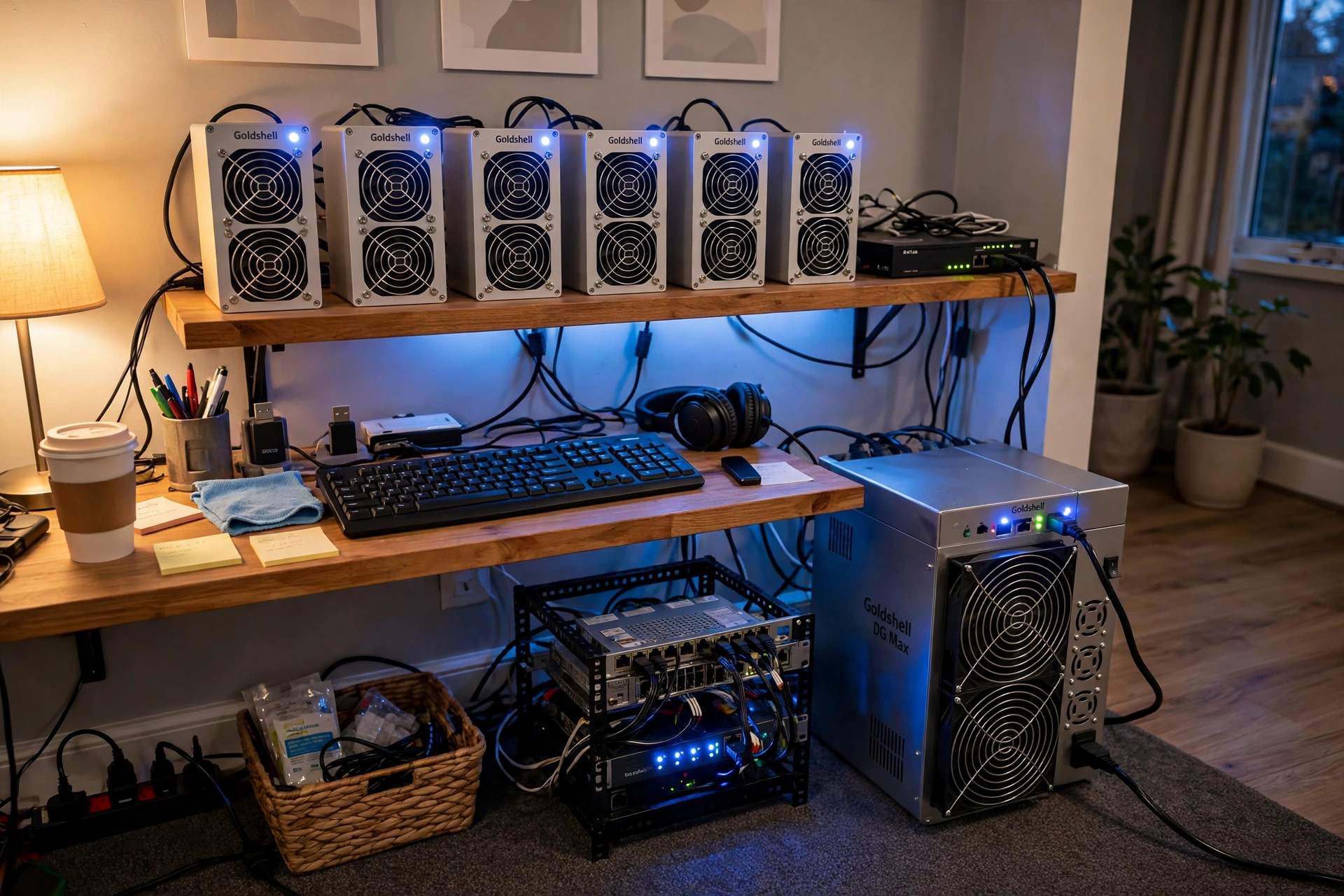
Goldshell miners are the home-mining fleet in the MineForgeX catalog: 13 models across six coins, from the $270 CK Box II to the $3,800 AE Max II. The range splits in two — quiet BOX units that run on a wall socket, and louder E-series and MAX units for a spare room or a small farm. In short: the KA-BOX Pro is the cheapest way in at $389, the KD Max is the most hashrate per dollar at $52.61 per terahash, and the DG Max is the Scrypt flagship at 6.5 GH/s.
The Goldshell Miners Range at a Glance
Goldshell was founded in Shanghai in 2017 on one idea: mining hardware that fits in a normal home. As of May 2024 it had delivered over 100,000 miners to more than 150 countries, and it was the first ASIC supplier to the Alephium mining community, from April 2024.
| Model | Coin | Hashrate | Power | Efficiency | Price | Cost per unit |
|---|---|---|---|---|---|---|
| Goldshell CK Box II | CKB | 2.1 TH/s | 400 W | 190 W/TH | $270 | $128.57/TH |
| Goldshell KA-BOX Pro 1.6T | KAS | 1.6 TH/s | 600 W | 375 W/TH | $389 | $243.13/TH |
| Goldshell AL-BOX II 720G | ALPH | 720 GH/s | 360 W | 500 W/TH | $449 | $623.61/TH |
| Goldshell Mini-DOGE III 650M | LTC/DOGE | 650 MH/s | 400 W | 0.61 J/MH | $549 | $844.62/GH |
| Goldshell AL Box III | ALPH | 1.25 TH/s | 600 W | 480 W/TH | $650 | $520.00/TH |
| Goldshell KD Box II | KDA | 5 TH/s | 400 W | 80 W/TH | $700 | $140.00/TH |
| Goldshell E-KA1M | KAS | 5.5 TH/s | 1,800 W | 327 W/TH | $1,500 | $272.73/TH |
| Goldshell AE Box II | ALEO | 54 MH/s | 530 W | 9.81 J/MH | $1,500 | $27.78/MH |
| Goldshell KD Max | KDA | 40.2 TH/s | 3,350 W | 83.3 W/TH | $2,115 | $52.61/TH |
| Goldshell E-DG1M | LTC/DOGE | 3.4 GH/s | 1,800 W | 529 J/GH | $2,400 | $705.88/GH |
| Goldshell E-AL1M | ALPH | 4.4 TH/s | 1,800 W | 409 W/TH | $2,540 | $577.27/TH |
| Goldshell DG Max | LTC/DOGE | 6.5 GH/s | 3,400 W | 523 J/GH | $2,800 | $430.77/GH |
| Goldshell AE Max II | ALEO | 540 MH/s | 3,200 W | 5.93 J/MH | $3,800 | $7.04/MH |
Efficiency units differ by algorithm — compare within a coin, not across coins: watts per terahash (W/TH) for Blake3, kHeavyHash, Blake2S and Eaglesong; joules per gigahash (J/GH) for Scrypt; joules per megahash (J/MH) for zkSNARK. Three models carry a 6-month warranty (AL-BOX II, KA-BOX Pro, Mini-DOGE III); the other ten carry 12 months. Four are Limited Allocation: E-KA1M, E-DG1M, AE Box II, AE Max II.
Home Miners: the BOX Series
The BOX series is why Goldshell exists: small, quiet miners for a living space, not a warehouse. Seven of the thirteen models are BOX units, all air-cooled on standard 100–240V power, and six run at 35 dB — about the level of a quiet conversation. The Goldshell KA-BOX Pro is the entry point at $389 ($243.13 per terahash), the cheapest way to mine Kaspa with a brand-new machine.
The other six cover one coin each: Alephium in the AL-BOX II ($449) and the AL Box III ($650, 12-month warranty); Litecoin and Dogecoin in the Mini-DOGE III ($549), the smallest of the three Scrypt models, which all earn two coins at once through merged mining; Kadena in the KD Box II ($700, 80 W/TH); Nervos in the CK Box II ($270, the cheapest miner in the catalog); and Aleo in the AE Box II ($1,500, Limited Allocation).
The trade for that quiet is scale: a BOX unit earns little each day. Buy one to learn mining, to heat a room, or to hold a position in a coin you believe in — not as the core of a commercial farm.
Fleet Units: E-Series and MAX Models
Above the BOX series sit six models: three E-series units and three MAX units, all air-cooled on 200–240V power, all louder at 45–80 dB. The E-series is the middle of the range: the E-AL1M (Alephium, 4.4 TH/s, $2,540), the E-KA1M (Kaspa, 5.5 TH/s, $1,500) and the E-DG1M (Litecoin and Dogecoin, 3.4 GH/s, $2,400). The E-KA1M is the standout — the cheapest Kaspa hashrate after the KA-BOX Pro, at $272.73 per terahash — but it is Limited Allocation.
The MAX units are the flagships: the Goldshell DG Max (Scrypt, 6.5 GH/s, $2,800, the most efficient Scrypt unit at 523 J/GH), the KD Max (40.2 TH/s, $2,115 — at $52.61 per terahash the cheapest hashrate per dollar of any Goldshell), and the AE Max II (Aleo, 540 MH/s, $3,800 — ten times the AE Box II's hashrate at two and a half times its price).
Moving from BOX to fleet unit is a step in infrastructure: a 200–240V circuit, a room that can clear 1,800–3,400 W of heat, and tolerance for 45–80 dB — the KD Max at 80 dB belongs in a garage or a farm hall. None of the six needs three-phase power or a coolant loop.
What Goldshell Miners Cost to Run
Altcoin revenue moves with the coin's price and network difficulty, so no honest guide can print a fixed daily profit for a Goldshell. What can be printed exactly is the power bill: watts × 24 hours × your power price ÷ 1,000. The table shows the daily power cost at $0.08 per kWh for all thirteen models.
| Model | Power | Daily power cost at $0.08/kWh | Cost per unit hashrate |
|---|---|---|---|
| Goldshell CK Box II | 400 W | $0.77 | $128.57/TH |
| Goldshell KA-BOX Pro 1.6T | 600 W | $1.15 | $243.13/TH |
| Goldshell AL-BOX II 720G | 360 W | $0.69 | $623.61/TH |
| Goldshell Mini-DOGE III 650M | 400 W | $0.77 | $844.62/GH |
| Goldshell AL Box III | 600 W | $1.15 | $520.00/TH |
| Goldshell KD Box II | 400 W | $0.77 | $140.00/TH |
| Goldshell E-KA1M | 1,800 W | $3.46 | $272.73/TH |
| Goldshell AE Box II | 530 W | $1.02 | $27.78/MH |
| Goldshell KD Max | 3,350 W | $6.43 | $52.61/TH |
| Goldshell E-DG1M | 1,800 W | $3.46 | $705.88/GH |
| Goldshell E-AL1M | 1,800 W | $3.46 | $577.27/TH |
| Goldshell DG Max | 3,400 W | $6.53 | $430.77/GH |
| Goldshell AE Max II | 3,200 W | $6.14 | $7.04/MH |
BOX units cost $0.69–$1.15 a day to run at $0.08 per kWh; fleet units cost $3.46–$6.53. The cheapest hashrate per dollar is the KD Max at $52.61 per terahash; the most expensive is the Mini-DOGE III at $844.62 per gigahash, because a home miner's price buys quiet and size as well as hashrate. To judge any model, run its hashrate through a mining calculator with the live coin price and difficulty, then compare the daily revenue against the daily power cost above: the break-even power price is the daily revenue divided by the daily kilowatt-hours, and any power price above it loses money.
Six Algorithms, Six Coins: Pick the Coin First
A Goldshell buyer chooses a coin first: each model mines exactly one algorithm. Alephium runs on Blake3 (three models, 720 GH/s to 4.4 TH/s); Kaspa on kHeavyHash (KA-BOX Pro, E-KA1M); Litecoin and Dogecoin on Scrypt, merged-mined — a miner on a Litecoin pool that supports merged mining earns Dogecoin on the same hashrate, with no extra power (see our Scrypt miners guide); Kadena on Blake2S (KD Box II, KD Max); Aleo on zkSNARK (AE Box II, AE Max II); Nervos on Eaglesong (CK Box II alone).
That coin-first choice is also a risk: a Goldshell's revenue follows its coin's price and difficulty, which move faster and further than Bitcoin's. The discipline is the same as any altcoin hardware — buy the coin you would hold anyway, size the power bill you can afford, and never count on today's coin price holding when the miner arrives.
Who Goldshell Suits — and Who Should Look Elsewhere
Goldshell suits three buyers: the home miner who wants a quiet machine on a normal socket and is happy with a small daily amount; the buyer who wants a position in one altcoin without buying it on an exchange; and the small farm that wants cheap hashrate per dollar in Kadena or Kaspa, where the KD Max and the E-KA1M lead the range.
A Goldshell is the wrong buy in three cases: a buyer who wants Bitcoin — no Goldshell mines SHA-256, so look at the Antminer, Whatsminer, Avalon, SealMiner or Teraflux ranges instead; a buyer paying $0.15 or more per kWh, where the daily power cost above nearly doubles and most BOX units cost more to run than they earn; and a buyer who needs silence in a living space and is looking at a fleet unit, which at 45–80 dB needs a separate room.
One clear next step: pick the coin, then the model, then request a quote with model, quantity, power price and destination — confirming availability first on the four Limited Allocation models.
Frequently Asked Questions
Which Goldshell miner is the best value in 2026?
The KD Max: 40.2 TH/s at 83.3 W/TH for $2,115, or $52.61 per terahash — the cheapest hashrate per dollar in the range. For a home miner, the KA-BOX Pro at $389 is the cheapest way into Kaspa mining with a brand-new machine.
Can I run a Goldshell miner at home?
Yes — the BOX series was built for it: seven models on standard 100–240V power at 35–38 dB, library-quiet. The fleet units need a 200–240V circuit and a room that can clear 1,800–3,400 W of heat, so they belong in a garage or a farm hall.
Do Goldshell miners mine Bitcoin?
No. Goldshell builds miners for altcoin algorithms: Blake3 for Alephium, kHeavyHash for Kaspa, Scrypt for Litecoin and Dogecoin, Blake2S for Kadena, zkSNARK for Aleo and Eaglesong for Nervos. Bitcoin mining needs SHA-256 hardware like the Antminer or Whatsminer ranges.
What warranty do Goldshell miners carry?
Six months on the AL-BOX II, the KA-BOX Pro and the Mini-DOGE III, and 12 months on the other ten, confirmed in writing on the quote. Four models are Limited Allocation — the E-KA1M, the E-DG1M, the AE Box II and the AE Max II — so confirm availability when you request the quote.
Discuss this with the MineForgeX team
Questions about the hardware, cooling, or deployment in this article? Request a quote for your facility.
Consult Team →