Market Economics
Bitcoin Mining in Paraguay 2026
Bitcoin mining in Paraguay 2026: the world’s #4 hub at ~43 EH/s, power at $0.04–0.05/kWh from Itaipu hydro — and the 31 Dec 2027 cliff. Request a quote.
#Market Economics #Paraguay #Latin America
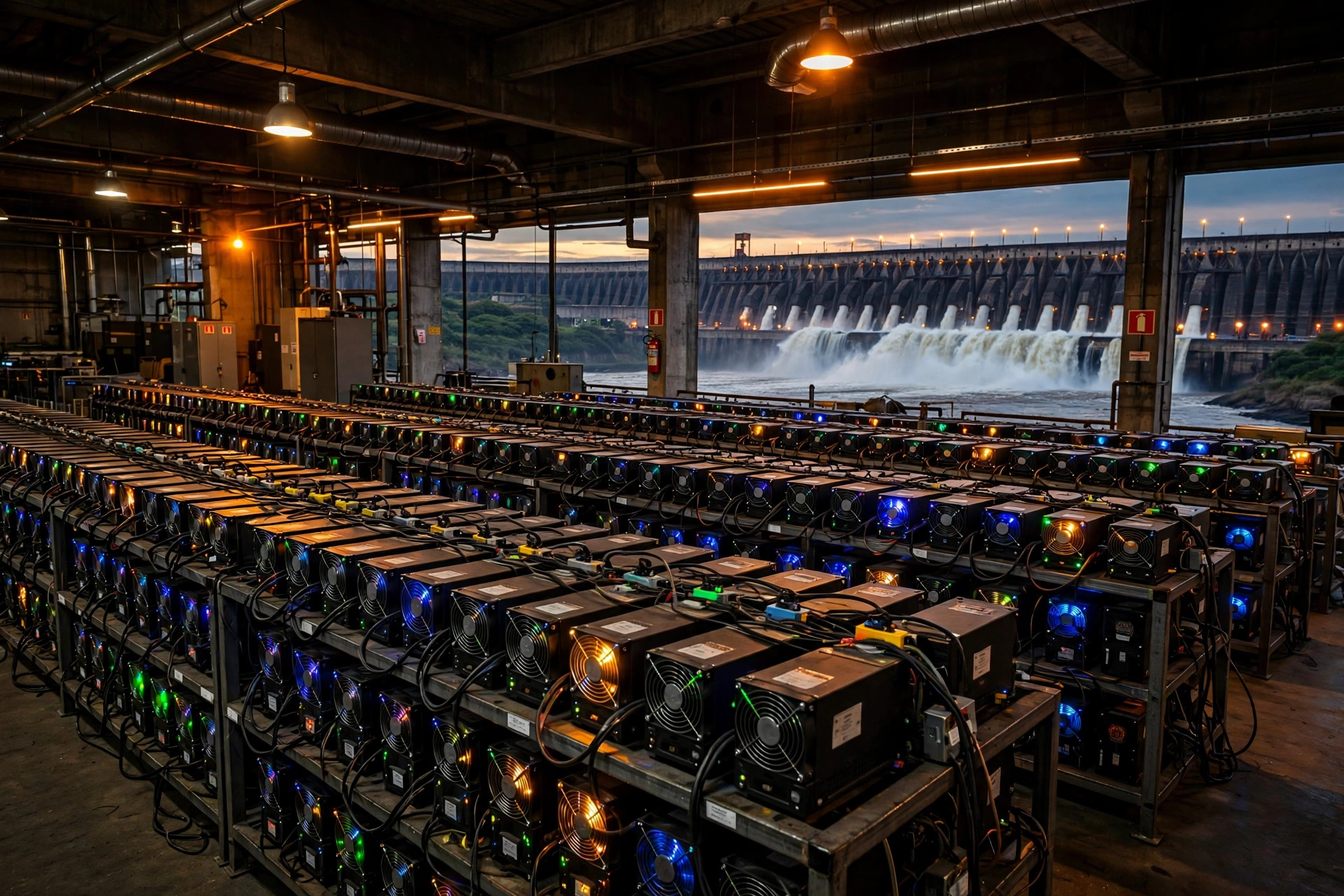
Bitcoin mining in Paraguay has made the country the world's fourth-largest mining hub, holding about 4.3% of global hashrate — 43 EH/s — on power that costs about $0.040–0.050 per kWh all-in from the Itaipu hydroelectric surplus. That combination is why institutional miners built there. The catch every buyer must plan around is the date: every mining power contract with the state utility ANDE expires on 31 December 2027, and artificial-intelligence data centers are now competing for the same power. This guide gives the verified numbers — tariffs, hashrate, rules — and the miners that fit a Paraguay deployment.
Why Bitcoin Mining in Paraguay Ranks Fourth Worldwide
Paraguay's mining story is a power story. The Itaipu Dam on the Paraná River has 14,000 MW of installed capacity across 20 turbines; under the 1973 treaty Paraguay owns half — 7,000 MW — which alone supplies roughly 86% of national electricity demand. Yacyretá (3,200 MW, shared with Argentina) and Acaray (230 MW) complete a grid that runs on 100% renewable energy. Seven million people cannot use what the dams produce: capacity is roughly 8,760 MW against peak demand of 5,280 MW, leaving a surplus of about 3,480 MW.
Miners took it. Paraguay held about 43 EH/s in Q2 2026 — 4.3% of global hashrate, fourth in the world behind the United States, Russia and China — and grew 54% year on year while global hashrate fell 5.8% in the quarter, to 1,004 EH/s. 41 licensed operators hold 943.8 MW of reserved capacity; four companies account for 730 MW. About 1,000 MW of the electricity matrix is tied to Bitcoin mining, supplying roughly 60% of the revenue ANDE earns from selling its surplus. HIVE Digital is the largest operator there.
What Electricity Actually Costs in Paraguay
Cheap power is the whole pitch, and the numbers are public because there is only one seller. ANDE, the state-owned Administración Nacional de Electricidad, bills miners under its own GCIE tariff for intensive industrial consumers, set by administrative resolution rather than a market. Under Resolution P/N° 49238 of 26 June 2024, energy at 220 kV costs US$0.03105 to US$0.03725 per kWh, peak to off-peak, before capacity charges. A demand charge of $5.27 per kW-month sits on top, working out to roughly $0.040–0.050 per kWh all-in at high utilization. Medium-tension connections pay more (~$0.05–0.06/kWh), and ANDE requires a three-month energy deposit upfront.
| Connection voltage | Energy charge (peak / off-peak) |
|---|---|
| 220 kV | $0.03725 / $0.03105 per kWh |
| 66 kV | $0.03765 / $0.03132 per kWh |
ANDE projects about $350 million from crypto miners in 2026, up from $295 million in 2025 and about $100 million in 2024, with miners paying a flat rate of roughly $44 per MWh. Two cautions: the tariff is not a subsidy — it reflects a fully depreciated hydro asset with near-zero marginal cost, so it can move with the politics around it. And it already has moved: rates rose 10–16% in 2024. The "cheap forever" assumption is the most expensive mistake a Paraguay buyer can make.
The 31 December 2027 Contract Cliff
Every mining power contract ANDE has signed expires on 31 December 2027, and the utility has said the date is non-negotiable. What replaces those contracts is still undecided. ANDE can also ask a miner to cut up to 95% of its load under the contract terms, so even inside the window the power is not unconditional.
The competition for what comes next is no longer just miners. AI data centers want the same cheap hydro: a company linked to the planned $12 billion Iguazú AI City has a 15-year power contract, X8 Cloud USA signed an MOU with ANDE for up to 500 MW of AI data-center capacity, and Decree 5306 (January 2026) offers AI and cloud companies 15-year fixed dollar tariffs. Engineers have proposed capping combined mining, AI and data-center allocations at 700 MW — against about 944 MW now held by miners. HIVE Digital — roughly 77% of its operating capacity is in Paraguay — has the most riding on the outcome.
Who holds the strongest hand
Well-capitalized operators with high-tension infrastructure and deep local integration are best placed in the renewal negotiations; mid-tier operators on medium-tension connections are already exiting. So the counterparty matters as much as the tariff: a hosting partner with a 220 kV connection and an ANDE relationship is a different risk from a reseller on medium tension.
The rules around mining in Paraguay
There is no law regulating cryptoasset mining in Paraguay. A bill that would have created one was vetoed in August 2022 and never became law; a 2024 Senate bill that would have banned mining has stalled without a floor vote since May 2024. The activity runs under Decree 7824 of 2022, ANDE's GCIE tariff category, and a miner registration requirement imposed in December 2024. Since March 2026, crypto transactions above $5,000 a year are reportable (DNIT Resolution 47/26).
Diverting electricity to mine carries up to 10 years in prison under Law 7300/2024, and ANDE reports 37 illegal mining farms totalling 91.8 MW shut down in 2024 and 2025. Buy only from licensed operators on a legal connection — a "cheap power" offer with no ANDE contract behind it is a risk, not a bargain.
Which Miners Fit Paraguay — and What They Cost to Run
Paraguay is subtropical: heat and humidity punish air cooling, and dust and moisture shorten service intervals. Hydro-cooled and immersion-cooled miners earn their premium here — a hydro block or an immersion tank holds full hashrate where an air-cooled unit throttles. At $0.045/kWh the gap between 9.5 J/TH and 17 J/TH is real money across a fleet, so efficiency, not just sticker price, decides the buy.
| Model | Hashrate | Power | Efficiency | Price | Cost per TH | Status |
|---|---|---|---|---|---|---|
| Antminer S21 Pro | 234 TH/s | 3,510 W | 15.0 J/TH | $2,949 | $12.60/TH | US Warehouse Ready |
| Whatsminer M60S+ | 210 TH/s | 3,570 W | 17.0 J/TH | $2,149 | $10.23/TH | In Stock |
| Antminer S23 | 318 TH/s | 3,498 W | 11.0 J/TH | $7,750 | $24.37/TH | Limited Allocation |
| Antminer S21 XP Hydro | 473 TH/s | 5,676 W | 12.0 J/TH | $6,999 | $14.80/TH | In Stock |
| Antminer S23 Hyd | 580 TH/s | 5,510 W | 9.5 J/TH | $13,300 | $22.93/TH | Limited Allocation |
| Whatsminer M66S+ Immersion | 318 TH/s | 5,406 W | 17.0 J/TH | $7,200 | $22.64/TH | In Stock |
Daily power cost is watts × 24 × $0.045 ÷ 1,000, using the midpoint of the $0.040–0.050 all-in range:
| Model | Power | Daily power cost |
|---|---|---|
| Antminer S21 Pro | 3,510 W | $3.79 |
| Whatsminer M60S+ | 3,570 W | $3.86 |
| Antminer S23 | 3,498 W | $3.78 |
| Antminer S21 XP Hydro | 5,676 W | $6.13 |
| Antminer S23 Hyd | 5,510 W | $5.95 |
| Whatsminer M66S+ Immersion | 5,406 W | $5.84 |
At the ends of the range the S21 Pro runs $3.37–$4.21 a day. The break-even test is the same as anywhere: daily revenue must exceed the daily power cost above. Revenue depends on the live Bitcoin price, network hashrate and pool fees, so run the numbers on the mining calculator with the day's figures before ordering — these power costs are fixed, but revenue is not a forecast.
- Voltage: the three hydro and immersion models need 380–415 V three-phase power; the air-cooled S21 Pro, M60S+ and S23 run on 200–240 V.
- Cooling: in Paraguay's climate, hydro and immersion models fit large deployments; air-cooled models suit smaller sites with good airflow and shade.
- Availability: the S23 Hyd and S23 are Limited Allocation — confirm stock on the quote. The S21 Pro is US Warehouse Ready and the M60S+ is in stock.
- Efficiency: the S23 Hyd at 9.5 J/TH is the most efficient machine here; the M60S+ at $10.23/TH is the cheapest hashrate per dollar — running cost versus capital cost.
How to Buy for a Paraguay Deployment
- For fleet and institutional buyers: pick the cooling class first — hydro or immersion for a large subtropical deployment, air-cooled for a smaller site. The Antminer S21 Pro is the value air-cooled pick at $12.60/TH; the S23 Hyd is the efficiency pick at 9.5 J/TH.
- For smaller buyers: the M60S+ and S21 Pro run on 200–240 V with no three-phase supply, so they fit a hosted slot or a small facility. For the cheapest hashrate per dollar, the Whatsminer M60S+ at $10.23/TH is in stock.
- Not for: deployments that only pay back if the tariff survives past 2027 unchanged, or hydro/immersion units bought without a 380–415 V three-phase supply.
- Delivery: every unit ships brand-new with insured DDP delivery to Paraguay, video QC before shipping and a 12-month warranty. Request a quote with the model, quantity, power price and destination; confirm availability on the two Limited Allocation models.
Frequently Asked Questions
Is Bitcoin mining legal in Paraguay?
Yes — mining is legal and operating; Paraguay is the world's fourth-largest mining country. There is no dedicated mining law (the 2022 bill was vetoed), so it runs under Decree 7824/2022, ANDE's GCIE tariff and a miner registration requirement.
What does electricity cost for Bitcoin mining in Paraguay?
Under ANDE's GCIE tariff (Resolution P/N° 49238, June 2024), energy at 220 kV costs $0.03105–0.03725 per kWh plus a $5.27 per kW-month demand charge — roughly $0.040–0.050 per kWh all-in. Medium-tension connections pay more, around $0.05–0.06 per kWh in industry reports.
What happens to miners after 31 December 2027?
Every ANDE mining power contract expires on 31 December 2027, and what replaces them is undecided. AI data centers are competing for the same power, and the utility has proposed capping combined mining, AI and data-center allocations at 700 MW. Operators with high-tension infrastructure hold the strongest hand; plan deployments to pay back inside the current window.
Which miner should I buy for Paraguay?
It depends on the site. For a large subtropical deployment, the hydro-cooled Antminer S23 Hyd (580 TH/s at 9.5 J/TH, $13,300) or the immersion-cooled Whatsminer M66S+ (318 TH/s, $7,200) hold full hashrate where air cooling struggles. For the cheapest hashrate per dollar, the Whatsminer M60S+ at $10.23/TH is in stock.
Pick the cooling class first — air, hydro or immersion — then request a quote with the model, quantity, power price and destination. Paraguay's power is the cheapest in the Americas, but only until 31 December 2027.
Discuss this with the MineForgeX team
Questions about the hardware, cooling, or deployment in this article? Request a quote for your facility.
Consult Team →